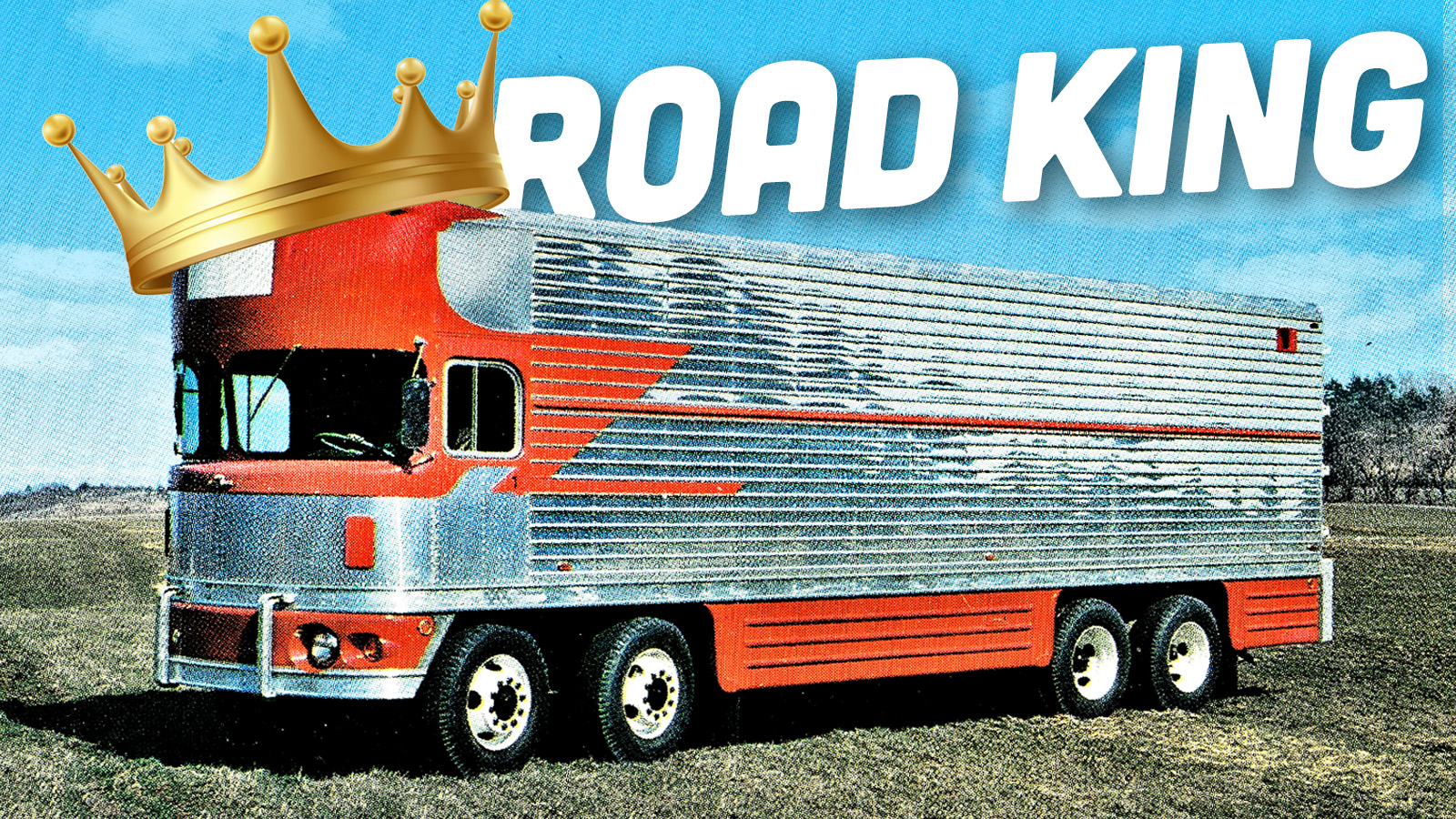
Throughout most of trucking history, manufacturers, fleets, and owner-operators had to contend with state-imposed regulations on total truck lengths and weights. These regulations often varied wildly, which meant that trucks might be legal in some states and not in others, in some cases even in neighboring states. In the 1950s, engineers tried to solve this problem with a big rig to rule them all: the McCullough Road King. The Road King was designed to beat regulations by combining the semi with the trailer, but it would never get a real chance to prove itself.
In 1982, the Surface Transportation Assistance Act (STAA) became law in the United States. Among other things, the Act set federal standards for the dimensions of Commercial Motor Vehicles (CMVs). According to the U.S. Department of Transportation Federal Highway Administration, STAA established a maximum commercial vehicle width of 102 inches, a minimum semi-trailer length of 48 feet, and no limit on total length. State semi-trailer length limits were allowed to be grandfathered, as long as the minimum was 48 feet. Many states chose trailer length limits of 48 feet or 53 feet. The common pick for semi-trailers today is 53 feet, in part due to these regulations, and in part due to 53 feet being a sort of sweet spot for fitting 26 pallets in a trailer while still maintaining maneuverability and keeping within weight limits.
Notably, the regulations do not limit the length of the semi-tractor itself. Because of this, the STAA led to the rise of the conventional semi-tractor — a design where the cab is behind the front axle, engine, and a long hood — to dominance in America. Conventional tractors are preferred by American drivers for their greater safety, roominess, and comfort over older American cabover designs, where the engine and cab sit atop the front axle.
 Kenworth
It was a long road to reach the STAA. During the early decades of the trucking industry, the federal government only regulated the economic side of trucking, leaving the states in control of determining what trucks were legal on their roads. The first state regulation on truck weight came from Maine in 1913, when that state said that trucks couldn’t be any heavier than 18,000 pounds. By 1933, all states had enacted regulations limiting truck dimensions and weights. While most states largely agreed on how wide a truck could be, weight and total length limits were chaotic. In most cases, length regulations were restrictive.
Because of these regulations, the cabover semi-tractor ruled the road for decades. A cabover generally takes up less length than a conventional, allowing for trailers to carry as much cargo as possible. The regulations also led to a sort of arms race where truck manufacturers competed to create the smallest, lightest, most creative cabover that could haul the largest loads.
In one infamous example, Curbside Classic notes, the railroad lobby successfully convinced the state of Illinois to limit trucks to no longer than 35 feet long. That way, allegedly, the Illinois trucking industry might be limited in growth, potentially allowing for a rise in freight rail traffic. This rule forced trucking firms in Illinois to get creative in their efforts to maximize how much cargo they could carry in such a short length.
 Used with permission from Dick Copello.
The coolest example (above) is how car carriers managed to fit five cars on a single transport by designing trucks that more or less allowed portions of cars to sit between the cab and the engine of cabover car haulers.
 Used with permission from fageol.com
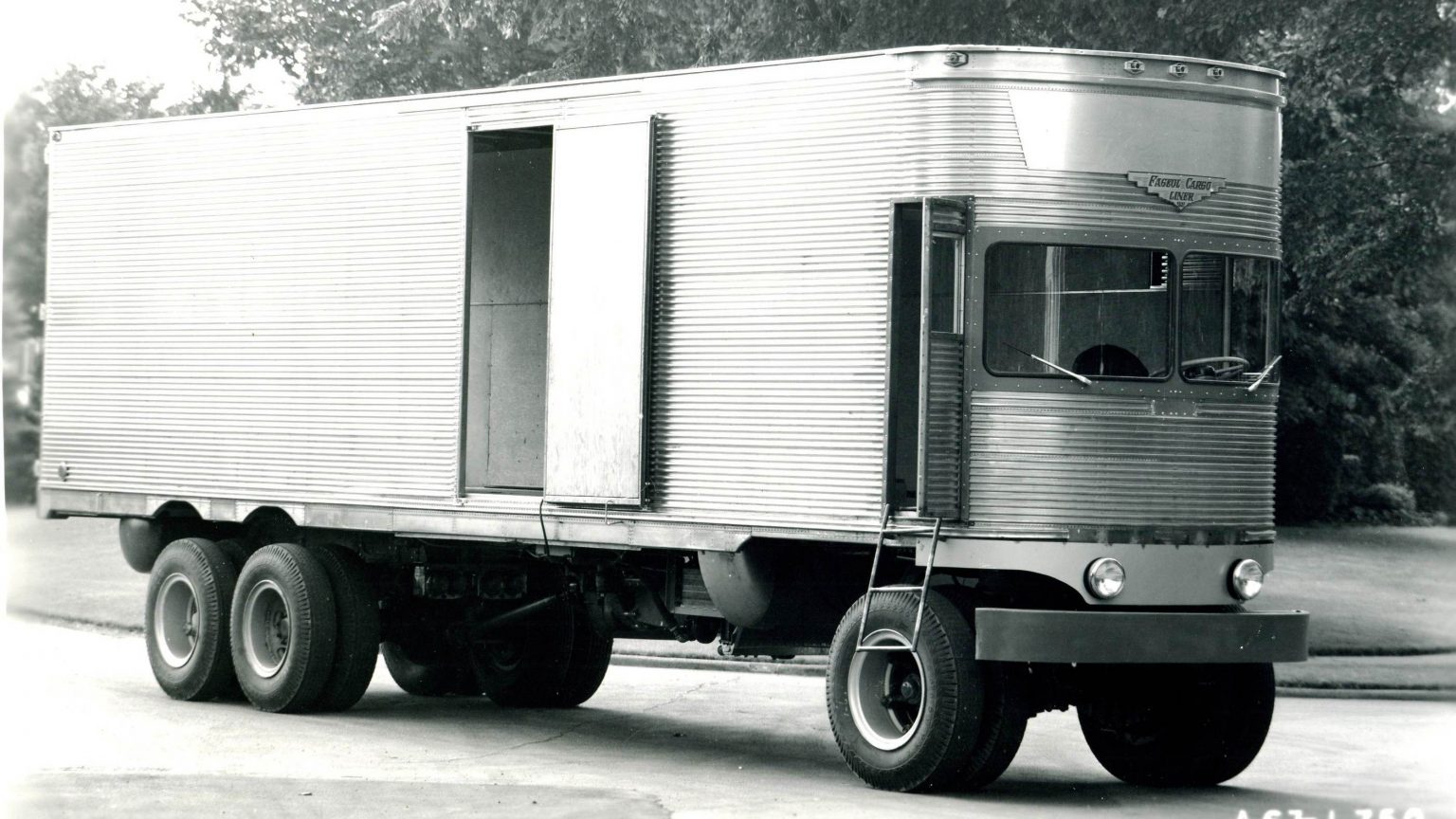
One of the boldest solutions to the length dilemma was to create a truck where the trailer and the tractor were a single unit. These unconventional designs include the 1945 Eisenhauer Twin Engine Truck, the 1950 Twin Coach CargoLiner, and the 1963 Highway Products Compac-Van.
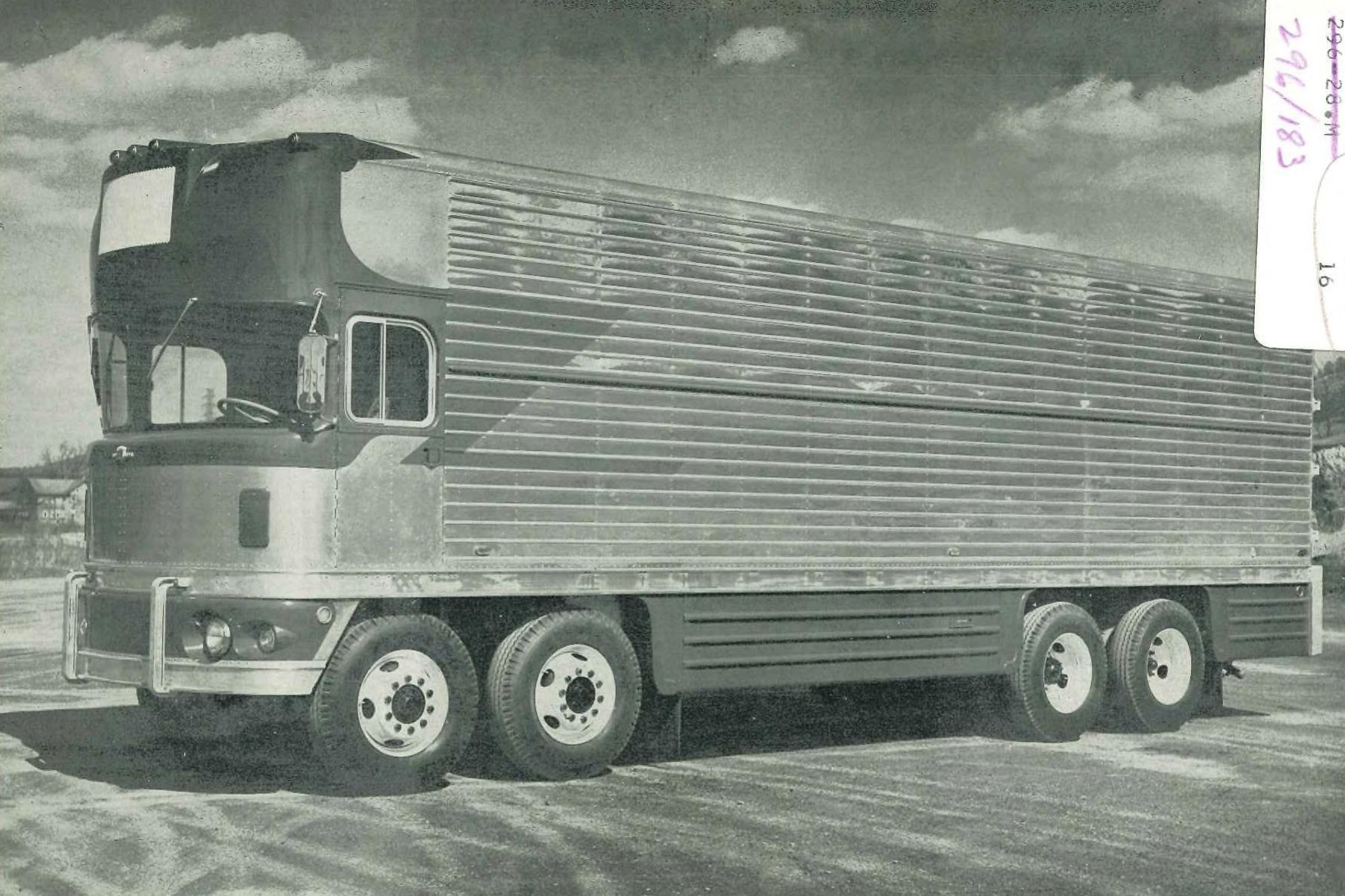
The grandest of all of these efforts was likely the 1954 McCullough Road King, and this truck isn’t just pretty and unusual for a highway truck. Its story also comes with a bit of a mystery.
 McCullough Motor Corporation
The Truck Without A Chassis
This story begins with a different company. In 1953, a startup company called McBright, Inc. out of Lehighton, Pennsylvania, announced it had an invention for the trucking world. Its new product was a highway truck, but it had tricks that other trucks didn’t have. Namely, this truck didn’t have a chassis or a separate trailer.
While the founders of McBright, Inc. and the reasons behind the company’s establishment remain unclear, the inventor behind McBright’s truck is known. The idea to build a truck with no chassis came from inventor William L. McCullough. In 1953, he sought a patent for a unique truck design. Here’s what he said about it:
 USPTO
USPTO
Under present day conditions, with rigorous restrictions imposed by numerous authorities on the size of the vehicle as well as the gross weight thereof permitted to travel roads under their jurisdiction, it is essential that the ratio of the pay load to the gross weight of the combined load and vehicle be kept as large as possible. While numerous attempts have been made heretofore to improve the usefulness and efficiency of highway cargo vehicles, these attempts have been aimed primarily at other aspects of the problem. For example, various attempts have been made to provide detachable, more or less self-contained units, such as power units and cargo-carrying units, which may be combined to form what are commonly called tractor-trailer combines. It has also been proposed to provide a detachable control unit for the purpose of having a combined arrangement of three independent but interconnected units, each of which being more or less self-supporting. While various advantages may be attributed to such constructions, none have been found which incorporate the advantages of a favorable ratio of pay load to gross weight, while at the same time making possible an overall reduction in gross weight as well as size of the unit.
Thus, under present day conditions, shippers of merchandise or cargo are often faced with the problem of choosing between shipping a reduced amount of cargo over the entire route or transshipping the cargo at one or more points along the route to avoid violating regulations enforced over part of the route to the destination. Very often, the combined weight of pay load and vehicle does not exceed the set maximum but the size of the vehicle does exceed the maximum size permitted in certain localities. This again poses the problem of transshipment, in this instance, to a smaller vehicle, before entering such localities unless a sufficiently small vehicle is used from the outset.
 USPTO
USPTO
McCullough’s solution was radical: eliminate the traditional chassis entirely and make the cargo-carrying body itself the structural backbone of the vehicle. By integrating the tractor and trailer into one self-supporting unit, the Road King could maximize payload capacity while minimizing overall length — threading the needle of state regulations that had long hampered the trucking industry. Though the design was innovative and the prototype impressive, the McCullough Road King never entered production, leaving one of trucking’s most ambitious engineering experiments as a fascinating footnote in the history of American freight transport.