This one isn’t going to be that hard. Chinese automakers, for all the advances they’ve made in car design (and van design), have had mixed results making a big SUV design that isn’t at least a little derivative. As Jean-Luc Godard once said, “It’s not where you take things from — it’s where you take them to.” Jaguar Land Rover disagrees, and is taking BYD to court.
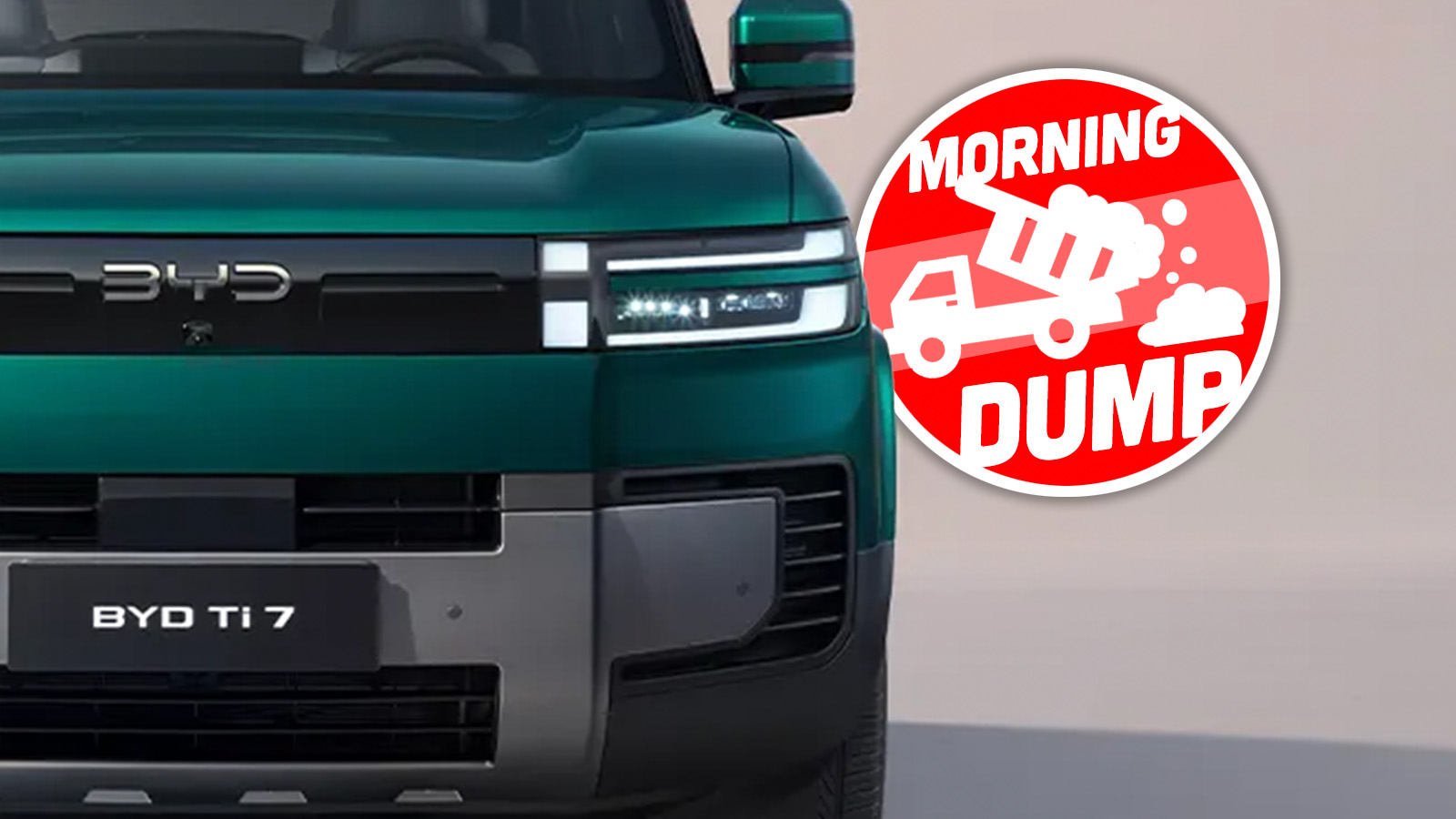
Today we’ll wade into the world of Chinese SUVs, starting with BYD’s Ti17, which sounds like a calculator. There was a previous piece about all the extremely Defender-like SUVs that Chinese automakers were importing, and the Ti17 didn’t even make that list — there are just too many to keep track of, which should get interesting if BYD is successful.
While Britain is happy to accept a bunch of Chinese EVs and hybrids for now, demand might be curtailed as the country’s government has signaled it’ll lower the requirements for zero-emission vehicles to give automakers and the market a chance to catch up. Meanwhile, Elon Musk is arguing that the cancellation of the Cybertruck has nothing to do with profitability and everything to do with robot cars — which will require a lot of processing power, though chips are increasingly being directed toward AI datacenters, and circuit board supply is feeling the crunch too.
Oh No, Not the Bailiffs
 Photo: BYD
BYD seems to have no issue defending its own copyright, even when its claims are totally bogus. When it comes to the intellectual property belonging to others, it’s a little sketchier — at least if you ask Jaguar Land Rover, which has taken BYD to court in the Netherlands over the design of the Ti17. The vehicle does sort of look like a Defender, though not necessarily more than any other Chinese automaker’s clone.
The difference here is that BYD is one of the world’s largest automakers and thus a great first target. If BYD can’t defend the case, then every other Chinese automaker copying the Defender design will likely have to deal with similar legal pressure going forward. According to The Sunday Times, JLR isn’t playing around:
Bailiffs acting on behalf of JLR seized digital records from BYD’s Dutch offices in Schiedam and Hoofddorp this summer.
[…]
Prior to the raid, BYD claimed it had done everything in its power to co-operate with requests for information from JLR. Lawyers for the Chinese company attacked the British firm’s move as a “fishing expedition” and claimed that “too many files were seized,” according to local reports.
JLR’s legal advisers claimed that BYD attempted to stonewall the seizure of the digital files. The bailiffs are said to have alleged that the Chinese company’s delaying tactics were unprecedented.
The court in The Hague is allegedly friendlier to intellectual property claims than other courts, making it a logical place to start the process. The reverse-engineering of cars is a pretty time-honored practice in the automotive industry, so it’ll be interesting to see if JLR is able to uncover something more damning than simply taking the car apart.
Britain Mulling a Drop in Zero EV Targets
 Photo credit: BYD
It turns out getting the entire world to switch to electric cars overnight isn’t easy, though it’s not impossible for a country like Norway. The United Kingdom formerly set a requirement that automakers reach 100% zero-emissions vehicles by 2035, including a target of 33% this year.
Reuters is reporting that this target may get scaled back:
Louise Haigh, the de facto deputy prime minister, is expected to finalise the plan on Wednesday. Haigh will probably approve a 2030 target of about 60% and extend flexibility until 2034.
But asked about the Guardian report on Monday, Prime Minister Andy Burnham said the government was still considering responses to a consultation on the matter. “No decision has been made at this point,” he told British media, calling the newspaper report “speculation.”
What Killed the Cybertruck?
 Photo credit: Tesla
Tesla CEO Elon Musk announced last week that the Cybertruck was going to die so that the Cybercab can live, prompting a wave of analysis about whether the Cybertruck was a failure.
Mack Hogan over at InsideEVs called it one of the biggest flops in automotive history:
Tesla delivered a product that came in years behind schedule. It underdelivered on almost every key spec at a price that was far higher than promised. Its novel production method drove up costs and contributed to high-profile quality issues. Its durability testing was clearly less rigorous than truck buyers expect, and its design was more polarizing than attractive. Meanwhile, the man behind it became politically toxic to the exact buyers most likely to go electric, and lost his interest in the human-driven car business altogether.
This failure lies primarily with him. Musk’s culture of promising before thinking, and lying without shame, created the culture that built one of the most overhyped and under-baked products in modern automotive history. Its failure will be studied for decades to come as an example of executive incompetence, just like the Edsel. That much is written.
[Ed Note: Mack makes some good points in his piece, especially about the truck underdelivering in numerous areas. From an engineering standpoint, though, the Cybertruck was actually quite impressive, as Jason Cammisa made clear in one of the first reviews of the truck, and as I did when I drove it. That’s not to say the Cybertruck is not a failure; even though it’s the best-selling EV pickup truck in the U.S., volumes have been well below expectations. -DT]
Musk took to X to push back, claiming there are still substantial reservations and that the truck was a success — just not as big a success as what comes next:
The Cybertruck order rate far exceeds our production rate. We will try to make as many as possible before shutting down the line in about 8 months, but will have to return deposits for a lot of people. This is not a case of Cybertruck being unprofitable, as has been misreported by legacy media, but rather that the opportunity cost of the complexity of the Cybertruck is vastly outweighed by prioritizing the Cybercab and other vehicles.
Whether the Cybertruck goes down in history as an engineering curiosity or a cautionary tale about executive overreach likely depends on who’s doing the studying — but either way, the stainless steel experiment is coming to an end.