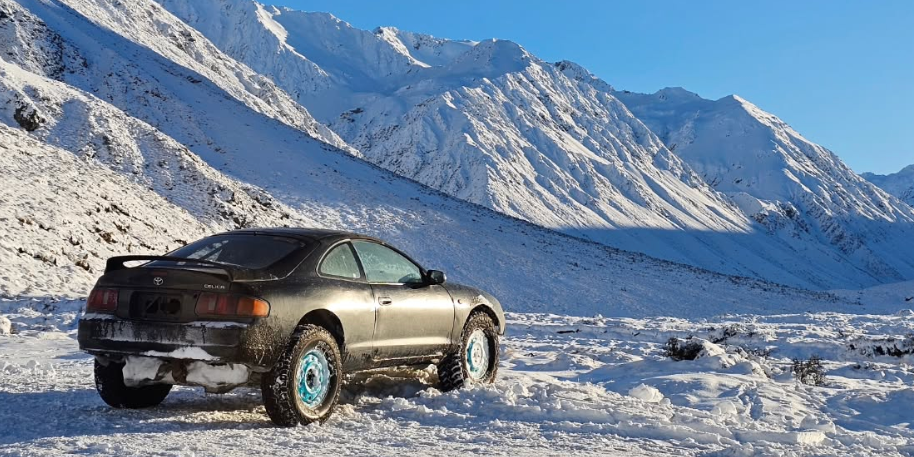
The art of modifying cars is gleefully rule-free. Sure, there are never-ending hoops to jump through for street legality, but actually building your perfect vehicle is merely a matter of dreams. For Kiwi Gareth Wadsworth, who goes by @garethcars on social media, those dreams meant stuffing two engines and two transmissions into a single sixth-generation Toyota Celica. Seems easy enough, right?
Wadsworth’s twin-engine Toyota Celica has made literal waves on social video in the past few weeks, as the Christchurch resident demonstrated its remarkable wading abilities in a series of viral videos. The basic recipe is a pair of Toyota’s 2.0-liter 3S-GE engines—one mounted in the front and one mounted in the rear—mated to a pair of manual transmissions and fed to individual differentials.
With so many moving parts, Wadsworth went analog with the controls; a pulley system attached to the original clutch pedal also operates the clutch for the rear transmission, and the throttle pedal is divided into an upper portion for the front engine and a lower portion for the rear engine. If you press directly in the middle of the accelerator, both engines will rev up (somewhat) in sync. Wadsworth emphasized that it is two completely separate drivetrains that require two of everything (two batteries, two fuel tanks, two ECUs, two radiators) and can be driven separately or simultaneously.
But this Celica build wasn’t always this extreme. In fact, the initial version was supposed to be a simple overlanding setup for a university off-road club trip in 2020. He initially off-roaded the Celica with a simple four-inch lift kit and 31-inch tires, but Wadsworth wanted to try something more extreme—and he didn’t want to abandon the existing platform.
“I had this Celica that I bought crashed, and I didn’t have anything to do with it. I was a student. I didn’t have the money for a four-wheel-drive, so I ended up building it into a four-wheel-drive,” Wadsworth said to Road & Track. “I paid $800 for the car, and then I sold the wheels and tires that were on it. So it was effectively a free car just sitting around, and I got some suspension left over from other projects that I threw in it, and the engine came from a crashed car I found upside down off the side of the road.”
After a year of mud-slinging fun, Wadsworth decided to go all-in on the dual-engine swap. The rear engine transplant only took two weeks, with most of the work happening after school and during a series of all-nighters. A day or two after the build was complete, Wadsworth and friends trailered the dual-engine Celica to an off-road area and began testing its abilities. Some limitations were quickly revealed.

Gareth Wadsworth
“It was just the stock intakes for a few trips. It did have a snorkel on the outside for the front engine. Once it was twin-engine, it had enough power that we could hit the water faster, and that meant that the bow wave would keep going over the roof and filling the front engine’s snorkel. We had one trip on the White Bear River that was in flood, and we hydrolocked the front engine twenty-three times, and we got sick of having to pull the spark plugs out, blasting the water out, and trying to get it running again. And so that’s why I moved the intake to the glove box,” Wadsworth said.
Wading is one of the twin-engine Celica’s best tricks, as it is fast enough to glide onto the water and light enough to float through. The Celica has floated through currents that have sunk heavier 4x4 trucks, Wadsworth said. But the twin-engine Celica doesn’t just excel at water crossings, either. Because the gearboxes run independently, Wadsworth can tune the gear ratios of either end to suit his needs.
“There’s no weird handling from the differences between the front and rear. It’s just whichever engine’s got the least load on it speeds up to catch up with the other one. They’re effectively a fifty-fifty split,” Wadsworth said. “Because of the biasing, I quite often run almost exclusively rear-wheel-drive, and I only add front when I need it for traction. It’s quite a unique feeling. It’s so much fun, and probably the main reason I’ve still got it is being able to dynamically shift between front, rear, or four-wheel-drive and throttle biasing on the fly. In a mud pit, I can sit around doing donuts with the front in neutral, and then I can put the front-end gear in and let the clutch out slowly on the front to transition from donuts to power slides.”
And it isn’t even too hard to drive—relatively speaking. Wadsworth said that his mates can hop in and romp it with minimal coaching, at least in this configuration. Shifting the two gearboxes can get awkward, but the rear transmission shifter is placed near the traditional shifter, so you don’t have to reach far. Before the pulley clutch system, Wadsworth wired the rear clutch through the parking brake, which required a gentle touch to keep from stalling.

Gareth Wadsworth
But it wasn’t always so accommodating. “On the original build, we didn’t have time to connect any of the controls, so it had two drivers back then. And we didn’t have a throttle, so the strap for tightening the hood was tied onto the rearview mirror and back to the rear throttle body, and you pulled it like a train horn,” Wadsworth said. “We certainly had a lot of difficulty driving it when we first built it, because it required two people to communicate—but it didn’t have any exhaust, so we couldn’t hear each other, and we had no total control on the rear; it was either fully on or fully off. And you had to get up out of your seat, turn around, and put it in gear for the rear engine.”
Even after six years of ownership and five years with two engines, Wadsworth plans to continue driving the twin-engine Celica as long as possible. Initially, he considered adding four-wheel steering using a power steering motor from a Nissan Leaf, but he said the time under the knife wouldn’t be worth it. The more time spent off-road, the better.