
Often it takes losing something — or having it stolen — to appreciate exactly what you had.
Creativity is expressed a million ways involving cars. One guy with an airbrush can turn the flanks of a 1975 Ford Econoline into art. Colin Chapman was relentlessly creative; somehow Banjo Matthews saw things in NASCAR chassis others couldn’t; it took Don Garlits to make rear-engine Top Fuel dragsters work; and Bill Stroppe revolutionized off-roading with the Big Oly Bronco. Throw in guys like Aurelio Lampredi, Marcello Gandini, Giorgetto Giugiaro, and a whole bunch of Germans too. All these people have been justly praised for their genius. Legends.

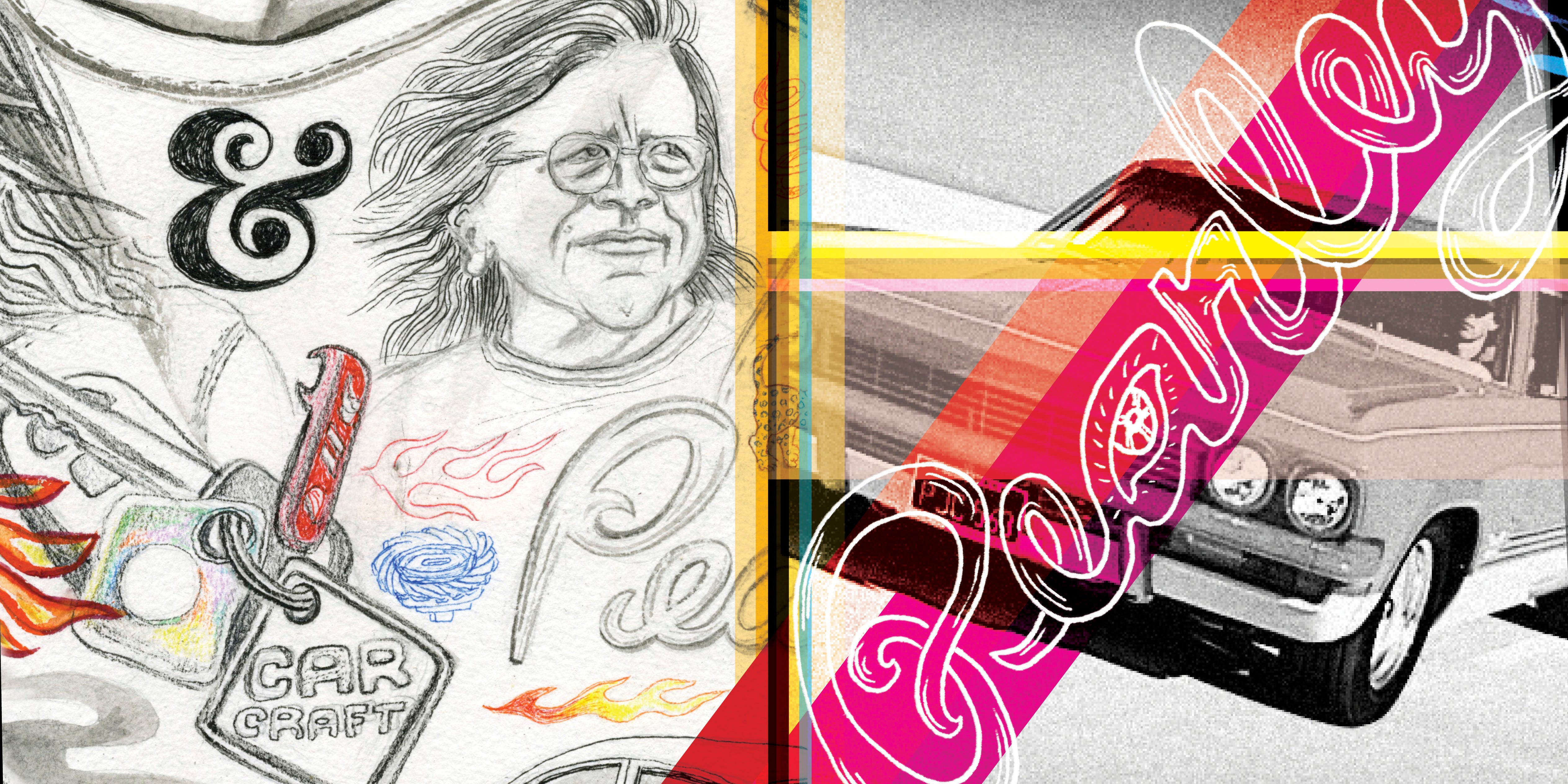
Car Craft magazine’s Project Heavy Metal 1965 Chevrolet Impala upon its completion in 1992.
Now, consider the bench racer. This is lower-level automotive creativity that most often results in … nothing. It’s those of us futzing around with Porsche’s configurator to precisely tweak our preferred 911 while overdrawn at Wells Fargo. It’s car lovers slugging down Michelob Ultras while sitting in lawn chairs describing how they’d build the perfect ‘69 Camaro. It’s me.
And this is the one time one of my silly notions became a real car. And then went back to only being a notion again. Because, thieves.
The Birth of Project Heavy Metal
In 1990, I was hired onto the staff of Car Craft magazine. It was a “wrench book” for folks with a passion for modifying American iron. It was my first job in magazines, and I was only beginning to learn both the medium’s limitations and my own.
There was already some softness appearing in the magazine market in early 1991. “We need to start something new,” my then-boss Jim McGowan said. Or at least he said something close to that. It’s a long time ago. Project cars were a go-to for magazines. “Let’s build an Impala,” I suggested.
At that time, the conventional wisdom was that no one cared about the big cars — it was all about Sixties and Seventies mid-size Chevelles and compact Camaros. But the state of California was then cracking down on modifying cars originally equipped with emissions controls. That was anything made after 1965. If Car Craft was going to do something different, but not too different, it had to be a 1965 Chevrolet Impala. Almost nothing else threaded the had-to-be-a-Chevy needle.
Several corporate machinations later, I found a red ‘65 Impala SS for sale in the San Fernando Valley. It cost $1,700. Tritely named “Project Heavy Metal” by my boss’s boss, Len Emanuelson, what resulted by the end of 1992 was a giant coupe, ultimately painted orange and beige for no reason, powered by a 560-plus-hp fuel-injected 496-cubic-inch (8.1-liter) big-block, and trimmed out in every hoary cliché of the early 1990s. That meant billet machined parts, tweed upholstery, and Center Line wheels.
I wanted larger diameter wheels, a simpler paint scheme, and a flat hood. But it still reflected my general idea. Generally. More or less. No car built by committee will reflect an individual’s ideas precisely. But the big idea — that big cars can be fun street machines — was my idea.

The big Chevys were all-new for 1965 and featured a stout perimeter frame and, for the time, an excellent suspension. My inspiration to do an Impala came from photos I saw of one in NASCAR race trim.
And the car was quick, running an 11.8-second quarter-mile with a 114-mph trap speed with an open exhaust and on eight-inch slicks. It also stopped well, with JFZ brakes swiped from NASCAR racing, handled amazingly for its size, and came out pretty great.
Stolen
So Heavy Metal was sent out on the car-show circuit, where the people charged with its care treated it abysmally. When it came back to Car Craft, we fixed what they had damaged and stored the car in a San Fernando Valley shop. Then I quit Car Craft in July 1993 and began freelancing.
Then Heavy Metal was stolen. Someone broke into the shop and took it in 1994. My friend Ed Taylor called to tell me. “The Impala is gone,” he said with an adamance just short of being punctuated with an exclamation point. “We came in this morning, and it was gone.” Nothing else in the shop was taken, so we spent about 20 minutes considering several conspiracy theories. Ed called the cops.
I had other things to worry about and figured whoever had taken Heavy Metal had already chopped it up. Then in 2002, a full eight years later, I was out with my infant son Jack, pushing him in a stroller around my Santa Barbara neighborhood. On Hope Avenue, literally 100 yards from my house but 100 miles from the shop from which the orange Impala had been stolen, there was a 1983 Ford Country Squire wagon with Heavy Metal’s fenders and fuel tank in it. They were hard to miss, being massive, orange-and-cream colored, and featuring the “496” and crossed-flag logo painted there by the great Steve Stanford. There was no other car those fenders could have been taken from. What the … ? Practically at my house?
I wrote a small item for Car Craft and left a note for the Country Squire’s owner to contact me. And that person did, saying he had bought the pieces in the wagon from a service guy at a Palmdale dealership. But after talking with him, I found my heart wasn’t in pursuing the fate of Heavy Metal any further. I didn’t have any financial interest in the car. It’s not as if I could file an insurance claim.
Looking back, though, I wish I had pushed harder to find out what became of it — because sometimes a car is more than just sheet metal and horsepower. Sometimes it’s the clearest proof you’ll ever have that the ideas rattling around in your head were worth something after all.