
Photo: Brett Berk. (left) There’s an authentic, familial feel to the observatory’s trucks. They are well-worn tools but also reflect the timeless, pragmatic character of the place. (right) “Something that big should dominate a landscape,” photographer Phelps says. “Instead, the field swallows it, softens it into something closer to a myth or a rumor than a machine. A lot of that light out there was doing its own quiet work too, that hazy, amber, low-sun glow that showed up on the second night, everything a little softened and gold, like even the light didn’t want to announce itself.”
If 23andMe analyzed petrolic lineage, Henry “H.A.” Taylor’s would assay as 100 percent unctuous. “I come from a diesel family,” he says. “Everybody drove diesel.”
This story originally appeared in Volume 37 of Road & Track.
When Taylor was a teenager in the Eighties in Pocahontas County, West Virginia, he parlayed this pedigree into a state championship at the Future Farmers of America agricultural mechanics competition.
“It started out simple, and then it got harder from there,” he says, his impish grin and tousled brown hair belying his 59 years. “They had a tractor that wouldn’t start, and you had to diagnose that. They had a small Briggs & Stratton engine, and you had to put it back together—it was already tore apart. You had to weld—vertical, horizontal, and overhead.”

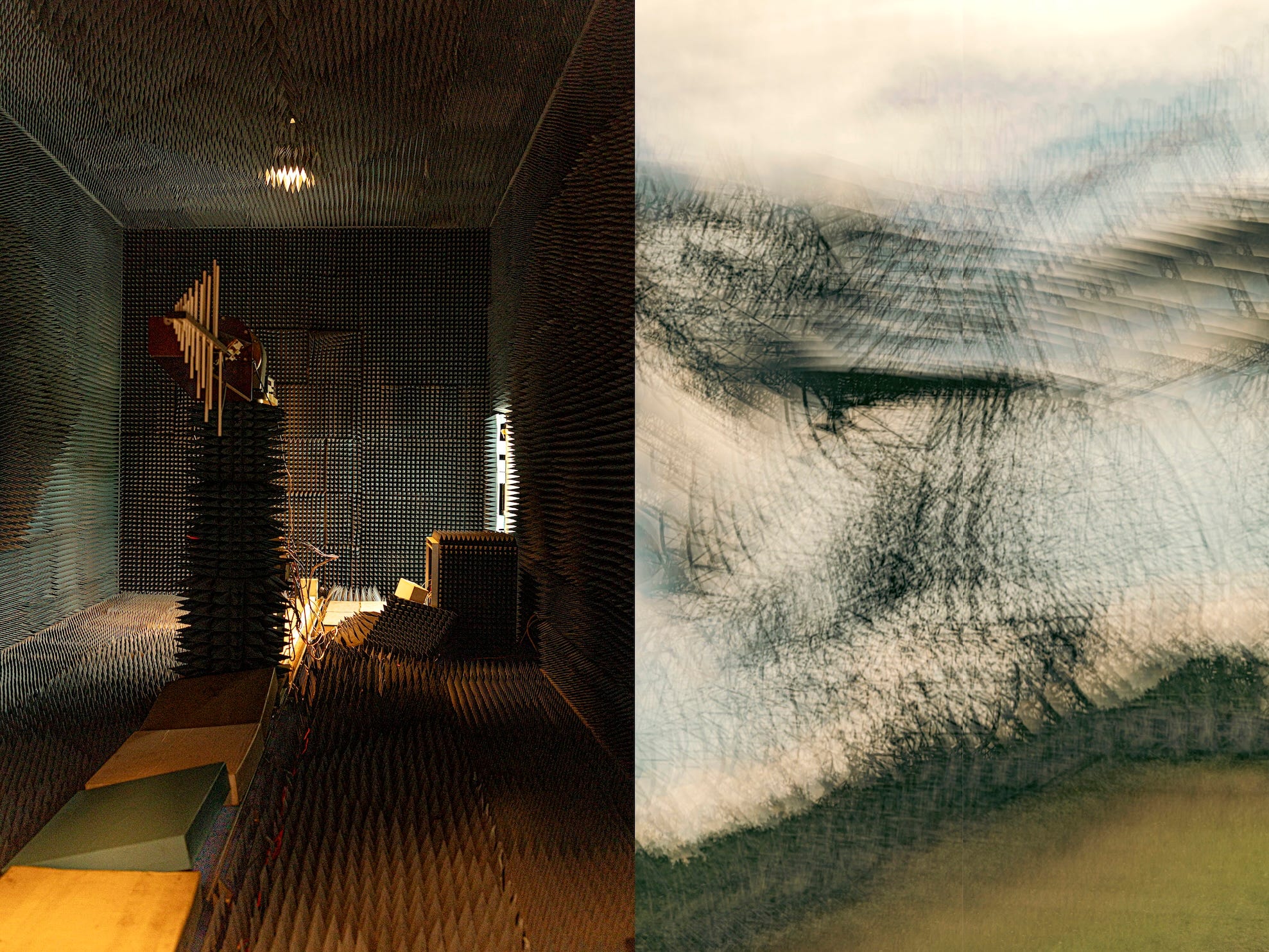
Photo: Bill Phelps. An anacoustic room, made to absorb all sound, is used to test and calibrate radio-telescope equipment.
His skills and bloodline have served him well. For 33 years, Taylor has worked in vehicle maintenance at the Green Bank Observatory, a facility founded by the U.S. National Science Foundation (NSF) featuring arrays of immense radio telescopes on a 3,200-acre campus in West Virginia. Since 1957, the site’s dishes have collected and refined the universe’s faint waves, converting them into decipherable electrical signals. They’re used for everything from mapping lunar surfaces to searching for extraterrestrial life to charting the trajectory of potentially impactful asteroids.
Because of their innate sensitivity, these devices must be shielded from radio frequency interference (RFI). Green Bank is thus situated within Appalachia’s approximately 13,000-square-mile National Radio Quiet Zone, where telecommunication, Wi-Fi, and broadcast transmitters must abide by strict regulations on signal strength and directionality.

Photo: Bill Phelps. (left) The Robert C. Byrd Green Bank Telescope, captured with an artistic blur. (right) A Checker Marathon’s cracks, dry rot, and rust lend a patina that tells a story of slow decay.
Restrictions are even more stringent for Green Bank’s 115 staffers and scientists, as well as its 50,000 annual visitors. Electronic devices must be powered off. Wireless tech is strictly prohibited. And because of the RFI emitted by ignition sparks, all on-site vehicles—used predominantly for two-mile trips from the main campus to the big scopes—are powered by compression ignition.
“There are about 76 pieces of equipment here with engines, and other than the weed eaters, everything runs on diesel,” Taylor says with the assurance of someone who services every motorized object on a strict six-week rotation.

Photo: Bill Phelps.
Taylor’s father and grandfather also worked at Green Bank, so he literally grew up in the facility’s expansive garage. His knowledge of its arcane vehicular history is personal and encyclopedic. It helps that many surviving vehicles still litter the property.

Taylor starts his tour with a tatty Checker Marathon. The first American passenger-car maker to offer a factory oil burner, Checker came out with diesel-powered cars in 1968—making Green Bank’s fleet of compression-ignition vehicles not just a scientific necessity, but a living archive of automotive history stretching back more than half a century.