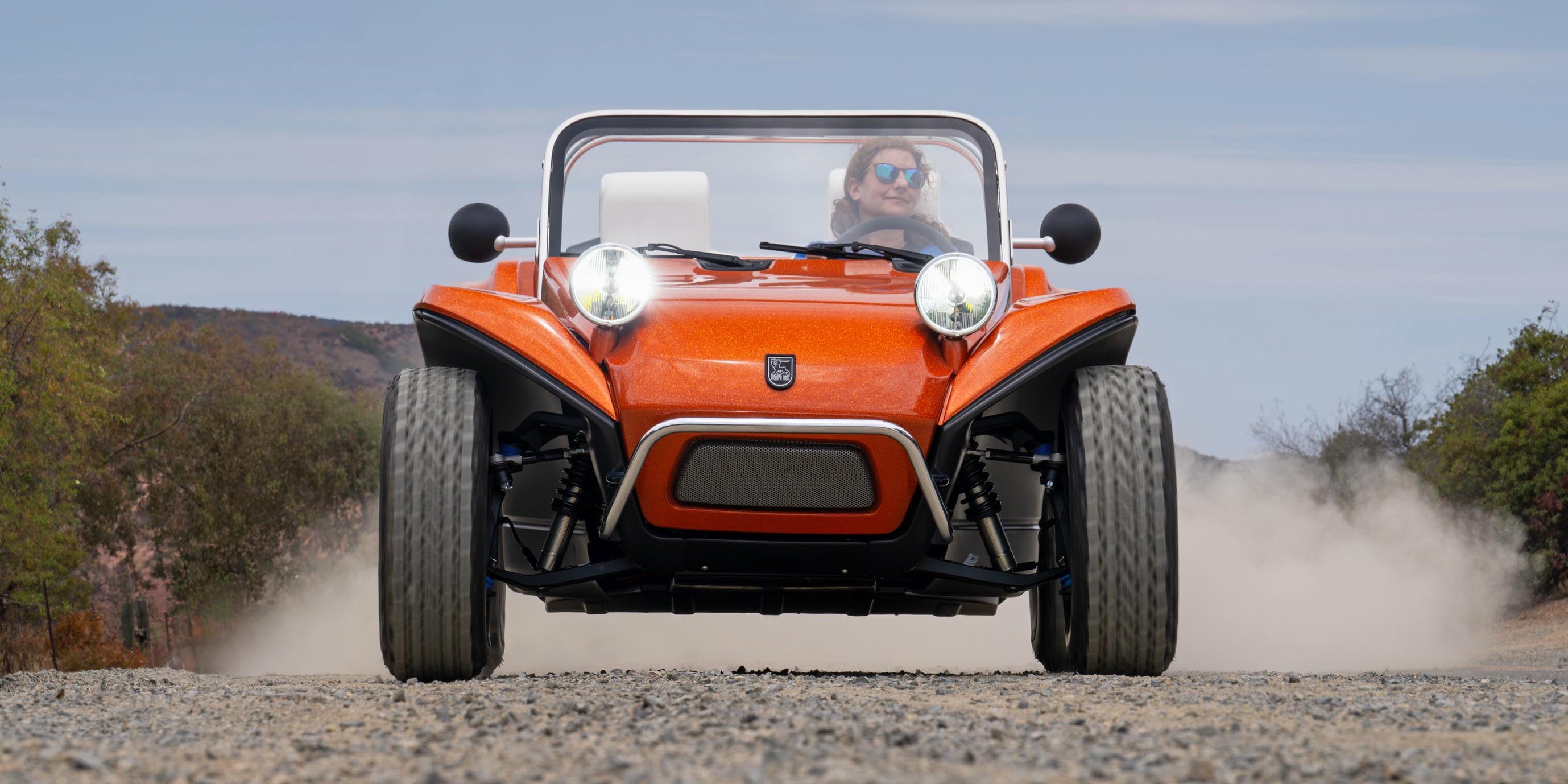
There’s the adorable, bouncy, fiberglass shell, finished in a metallic orange that boasts more glitter than a bass lure. At the front, cheerful fender-mounted headlights make eyes at all the passing cuties, and you, in your open-air buggy, are a cutie yourself. Beneath its familiar, friendly exterior, though, this Manx has a secret. It’s one you’ll discover as soon as it wooshes by with no Volkswagen clatter or shouty flat-six, just the giggles of the driver and passenger over the whirr of an electric motor.
Meyers Manx has been kicking around the idea of an electric buggy for more than a decade. Manx’s inventor, Bruce Meyers, had been considering it back in 2014, well before he sold the company to Phillip Sarofim and Freeman Thomas, but he never got past the golf-cartish mock-up stage. Under Thomas and Sarofim, a street-legal electric Manx became a reality, with a sophisticated prototype first seen on the lawn of The Quail during Monterey Car Week in 2022.
On Friday, August 14, 2026, the Manx EV will return to The Quail, now in nearly production trim. We weaseled our way into a test drive before the Manx team packed up for Monterey and went ripping through the hills above Lake Forest, California, in a Launch Edition Manx 2.0.
From Concept to Production
The production Manx 2.0 isn’t identical to the prototype we first covered. The range is less, the weight is more, and it’s likely not quite as zippy as the initially proposed 4.5-second zero-to-60-mph run. “We’ve gone through various iterations trying to find the right combination of construction, battery, powertrain,” says Manx head of sales, Chet Parsons. “The first car was a showpiece concept car. The production car is more in line with the originals in some ways while functionally improving it in others.”
There’s no need to improve the exterior design, and thankfully, fans of the classic Manx will recognize the 2.0’s distinctive shape. The electric Manx maintains similar dimensions to the original, with a nearly identical height and wheelbase, but it’s shorter and wider overall. The main visual differences are a deeper tub to contain the L-shaped, liquid-cooled battery and a closed-off rear panel, since there’s no need for an engine cut-out.
Powertrain and Performance
Instead of hanging out the back, the propulsive elements of the 2.0 are sandwiched under the belly and at the rear axle. A single motor and 45-kWh battery send 181 horsepower and 385 pound-feet of torque to the 265/70R-15 General Grabber all-terrain tires at the rear. Narrower 205 Grabbers handle the steering at the front. Manx says the combo should be good for an estimated 100 miles of range, which is about as long as you’d want to drive in an open buggy before stopping to reapply sunscreen.
There wasn’t time for track testing before Monterey. Still, with more than double the power of a stock Beetle engine — even the high-horsepower versions — the E-Manx is undoubtedly quicker off the line than the other performance options in the Manx lineup, which include a 100-hp souped-up VW four-cylinder and a wild 130-hp radial engine.
Not only is the EV quick, but it’s also easy to drive, with a single-speed automatic transmission and a mechanical limited-slip diff, which Manx hopes equals just the right combination of old-school shenanigans and modern convenience to appeal to customers who want to channel their inner Thomas Crown Affair, but haven’t mastered the manual.
Launch Edition Colors and Construction
While Manx offers the Classic and Resorter models in a rainbow of gel-coat options, the 2.0 will start out with just two different Launch Edition colorways. Manx plans to build 50 in the green and plaid first seen on the prototype, and 50 in the sparkling creamsicle combination of metallic orange and white.

Another major difference from the classic Manxes is in the construction. Gas-powered buggies still use a modified VW Bug chassis, but the 2.0 rides on a steel tube frame, which allowed Manx to fit it with more modern coil-over suspension, an adjustable steering column, and a structural roll bar. As a driving experience, it’s much tighter and more predictable than the gentle wandering of a vintage buggy.
Four-wheel disc brakes make the Manx as easy to stop as it is to launch, although our test car’s brakes were unboosted and without ABS. We didn’t find that difficult to manage, but if Manx wants to sell to a less mechanically savvy crowd, it may upgrade that in the future. The same goes for the unassisted steering, which was pleasant at speed, but heavy while parking.


Behind the Wheel
The fun of driving the Manx begins as soon as you approach it. The sun hits the metalflake and explodes into rainbows. There are no doors; you just fling a leg over the side like a cowboy mounting up for a ride and hoist yourself into the white bucket seat. Unlike a classic Manx, which might have lap belts or no belts, the 2.0 has sturdy three-point harnesses to keep you from bouncing out. Not that you would — this version of the Manx rides smoothly on Bilstein dampers.
Turn the key at the base of the shifter and a center-mounted screen lights up in a cool blue glow. Pull the sequential shifter handle back into Drive — this requires a bit of squinting at the screen in bright sunlight to be sure which gear you’re in — and the Manx is ready to rumble.
Or not rumble, as the case may be. At first we found the lack of exhaust note from the rear disconcerting. It’s such a part of a Manx experience to hear the engine popping and snorting, but it was nice to be able to have a conversation without shouting. After a few miles, we got used to smelling desert sage instead of gasoline. An off-road experience in the 2.0 would be serene with just the sound of the coast and the birds.
Price and Target Buyer
With DC fast-charging compatibility, vehicle-to-load charging, storage under the frunk and in the rear cubby, and 50-state street legality under the Low Volume Manufacturers Act of 2015, Manx sees the 2.0 as an ideal ranch or island runabout for a subset of wealthy enthusiasts who recognize Bruce’s free-spirit energy in the Manx design — and are willing to pay $125,000 to have it delivered turn-key rather than build one piecemeal.