From the November/December 2026 issue of Car and Driver.
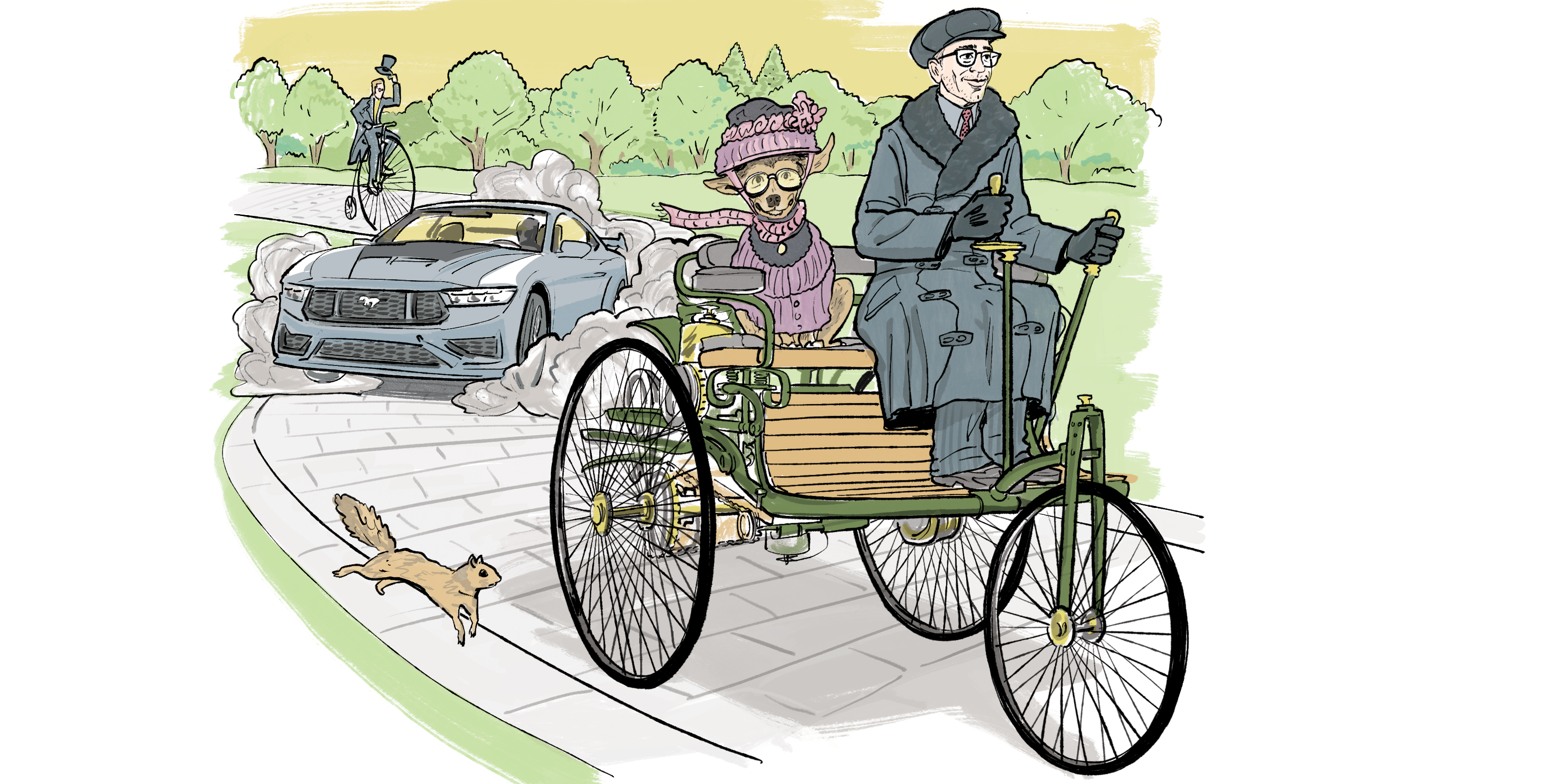
Editor-in-chief Tony Quiroga has developed a taste for the very distant automotive past. At Monterey Car Week, he drove the 1886 Benz Patent Motorwagen, which gives him a solid answer to the question of the oldest car he has driven. The only possible challenger would be someone who has driven Cugnot’s steam car.
Why the Motorwagen Counts as the First Car
The Patent Motorwagen is widely credited as the first car because Carl Benz designed it as a car from the start. He did not simply convert a horse-drawn carriage by adding an engine and drivetrain and removing the horse.
A Vehicle Before Anything Was Figured Out
Quiroga loves early machines because so many things we take for granted had not yet been worked out. Designers made plenty of guesses, some right and some wrong. Driving such a vehicle is disorienting, challenging, and at times dangerous, since something might explode or you might fall out. Boring had not yet been engineered into the experience.
The Motorwagen looks a bit like an oversized baby carriage. It has three wheels to keep it simple and light. Carriages of the era pivoted their whole axle, because wheel uprights and kingpins were still years away. The steering control resembles the wooden handle of an awl, since the steering wheel had not been invented. Carburetor jets, radiators, radios, and tetanus shots did not exist either.
Another unimagined idea was covering the moving parts. The crank, connecting rod, cam gear, and drive belt all sit exposed, and some must be greased before a drive. Drip lubricators feed oil to the cylinder and intake valve, and the excess runs over less critical parts and leaves a greasy trail on the road.

Photo: George Lepp / Car and Driver. Strictly speaking, the car Quiroga drove was a reproduction built by Mercedes-Benz, but this issue still covers vehicles from three centuries.
Starting, Going, and Stopping
Starting the car means switching on the ignition, which feeds a spark plug roughly eight inches long, and then spinning the horizontal flywheel by hand. The air-and-hexane fuel mixture is adjustable, so you can enrich it to help the engine catch. The original fuel was naphtha, sold at apothecaries in 1886. There is no throttle, so the 1.0-liter engine stays near its 400-rpm operating speed. A 4.8-quart copper vessel above the engine holds the cooling water. It boils over after about an hour, so the driver has to stop and wait for things to cool.
To move off, you push a long lever on the left side of the leather-trimmed bench seat, which engages a leather belt driven by the engine to the axle. That delivers 0.88 horsepower. Pulling the lever back stops the car by dragging a shoe against the axle. Quiroga says it is easy enough for a toddler to drive. Its claimed top speed is 13 mph, and he calls it the most amazing 13 mph he has experienced. He doubts he will be this much fun at 140 years old.
Early Cars on the Road
Senior features editor Elana Scherr shares his enthusiasm for very old cars. She owns a 1915 Dodge, which made her the right person to organize a U.S. counterpart to Britain’s London-to-Brighton run for early cars. Quiroga rode along and exceeded a 45-mph speed limit in a 116-year-old Pullman, which he takes as proof that speed limits are set too low. He notes he was running Waze to stay out of trouble. Scherr’s account begins on page 64.

Photo: James Lipman / Car and Driver
Something Newer in This Issue
Readers who would rather not go antiquing have plenty of modern options. The issue includes a 795-hp Mustang on page 34, a nearly 1000-hp Audi supercar on page 58, and the new Corvette Grand Sport on page 72. With both new and old on offer, Quiroga calls it a great issue.