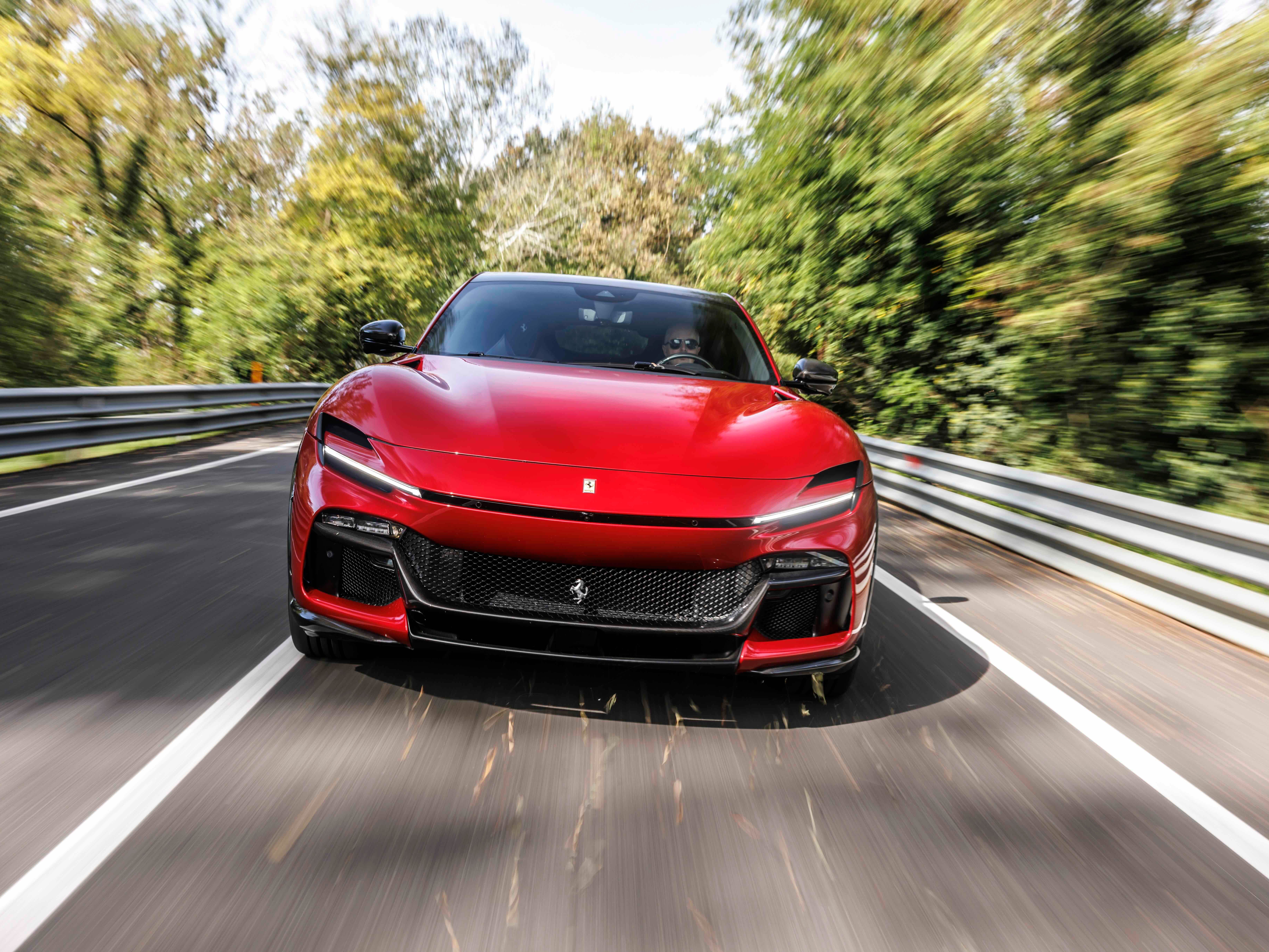
Ferrari’s decision to produce an almost-SUV was a controversial one, but hindsight has proved the Purosangue to be a hit for the world’s most famous supercar maker, with ultra-wealthy buyers wanting to combine the thrills of one of the company’s famous V-12s with practicality and space for four. Now Ferrari is offering an additional choice with the launch of the Handling Speciale package to sharpen the driving experience. Is this a must-tick box for Purosangue buyers?
Our expert editors test every vehicle we review. Read more about how we test and review cars here.
The Lowdown
Ferrari has offered Handling Speciale versions before, most recently with the California T in 2016. The HS pack shouldn’t be confused with extensively modified cars like the 296 Speciale; essentially it is a set of software tweaks for various dynamic systems. For the Purosangue that means a firmer tune for the active suspension system and a punchier shift algorithm for the dual-clutch transmission, plus other smaller enhancements.
Mechanically, the Handling Speciale is unchanged over the standard Purosangue, using the same 6.5-liter naturally aspirated V-12 making peaks of 715 hp and 528 lb-ft of torque. It also keeps the same innovative all-wheel-drive system: the eight-speed transmission only powers the rear wheels, while torque is sent to the front axle through a two-speed power transfer connection driven from the front of the engine.
- Vehicle Tested: 2027 Ferrari Purosangue Handling Speciale
- Base Price: $460,760
- Price as Tested: TBC
- Test Location: Balocco Proving Ground, Italy
How Does It Drive?
Experience was limited to the Balocco Proving Ground in Italy, specifically the three-mile-long Langhe Internal course — designed to replicate a typical European country road, but with the advantage of no oncoming traffic.
Within those limitations, the Handling Speciale acquitted itself well. Ferrari has long argued that the Purosangue is not an SUV but rather a “Ferrari Utility Vehicle.” Semantics aside, the brand does have a point: it doesn’t drive like more traditional ultra-luxury SUV rivals like the Lamborghini Urus. Think of the Purosangue as being a higher-riding V-12 Ferrari grand tourer, one which has four doors and four seats.
There was a definite finesse to the way the Handling Speciale tackled the course at Balocco. The Ferrari steered with precision and gripped hard but also surrendered adhesion gracefully as it approached its limits. As with R&T’s previous experience, the naturally aspirated 6.5-liter V-12 remains the Handling Speciale’s starring feature and also the main point of distinction compared to the turbocharged V-8 alternatives. As in the 12Cilindri, there isn’t a heap of low-down torque, although the engine pulls cleanly from basement revs. But working the V-12 harder turns it progressively more special, with an orchestral cacophony of sound building as the rendered tachometer needle sweeps upward toward the 7750 rpm at which peak power is delivered. The Handling Speciale has no more power than the regular car, but it does get a more muscular exhaust note under load and at higher revs.
Although the Handling Speciale’s hardware is unaltered, software tweaks to the active suspension — which uses an electric anti-roll system as well as TrueActive Spool Valve adaptive dampers — have added firmness across all drive modes. The softest of these, Wet, still felt pliant over the few rough surfaces the test track offered. The quick-acting dynamic brain and the Purosangue’s generous suspension travel give it the ability to smooth out dips and bumps that would definitely be jolting the cabin of a lower and more traditional Ferrari. Even selecting the more aggressive Sport mode and putting the dampers into their Firm setting (which can be toggled separately by pressing the manettino dial on the steering wheel) didn’t make it feel harsh at any point.
While the Handling Speciale resists understeer impressively well, the car’s mass was still obvious in the proving ground’s tighter corners and over bigger crests. Ferrari quotes a dry weight of 4482 pounds, so figure somewhere around 4800 pounds once loaded with fluids. Barring the Luce EV, this is the heaviest Ferrari. That felt obvious when carrying braking pressure into Balocco’s tighter corners to get the rear of the car to rotate, sometimes to the point of gentle oversteer even with the stability control still turned on. Learning the need to hold a beat past the apex before getting hard onto the throttle was essential for a tidy exit.
A rear-steering system improves reactions invisibly at lower speeds, intervening much more subtly than the systems used by some other automakers. The Purosangue HS felt notably athletic for something so tall and heavy, though the driving experience will always be a ways removed from the intensity of dynamic connection found in the brand’s lower, lighter models.
The retuned transmission software for the eight-speed dual-clutch allows for savagely fast gearchanges, and the manual mode handled requests for multiple downshifts heading into tighter turns without hesitation. But even in the gentlest Wet mode, shifts could still be felt, the gearbox lacking the smoothness of a torque converter. That’s probably a compromise most Purosangue buyers will be happy to make.
What’s It Like to Live With?
Anybody wanting to know if a Purosangue is a Handling Speciale version will have to look for some subtle differences. The most obvious is the carbon-fiber finish for the Prancing Horse shield on the fenders, one that isn’t available on the regular car. Similarly, the Ferrari branding at the rear gains a new satin finish.
The new package brings no difference to the Purosangue’s cabin, which offers the combination of beautiful materials with some perplexing details. A purple interior trim combined strikingly well with the traditional red exterior on the test car, but Ferrari’s decision not to give the Purosangue a central touchscreen — in a part of the market where buyers expect good usability to come as standard — remains a puzzling one.
There would be enough room on the dashboard for a modestly sized screen, certainly if Ferrari got rid of the passenger-side display that serves little obvious purpose except to relay impressive performance numbers. Trying to use Ferrari’s UI system through small menus on the digital instrument pack, and with fiddly buttons on the steering wheel, remains an exercise in deep frustration. That’s true across the range, but it feels more incongruous in what is meant to be a family-friendly vehicle.
Ferrari does deserve credit for some neat design details, however. The Purosangue has room for four adults, and even if rear passengers are likely to feel a little squashed, they enjoy the novelty of both rear-hinged doors and a higher seating position that gives a better view forward. Testing at Balocco also revealed the lack of lateral support from the standard comfort seats under prolonged lateral-g loading, with no sport-seat option available. Few owners are likely to regularly track their car, of course, but it is another indication of the Purosangue’s different priorities from other Ferraris.
Should I Buy One?
Within the surreal realms of ordering and specifying a Purosangue, ticking the box for the Handling Speciale pack feels like a positively sensible thing to do. Ferrari is charging $27,600 for it — a modest amount by the standards of Ferrari options. The software-focused nature of the upgrades means there is no significant weight penalty, and the sharper suspension and transmission calibrations deliver a genuinely more engaging driving experience without sacrificing everyday usability. For buyers already committed to the Purosangue’s particular vision of a V-12 Ferrari that can carry the family in style, the Handling Speciale package is well worth adding to the order form.