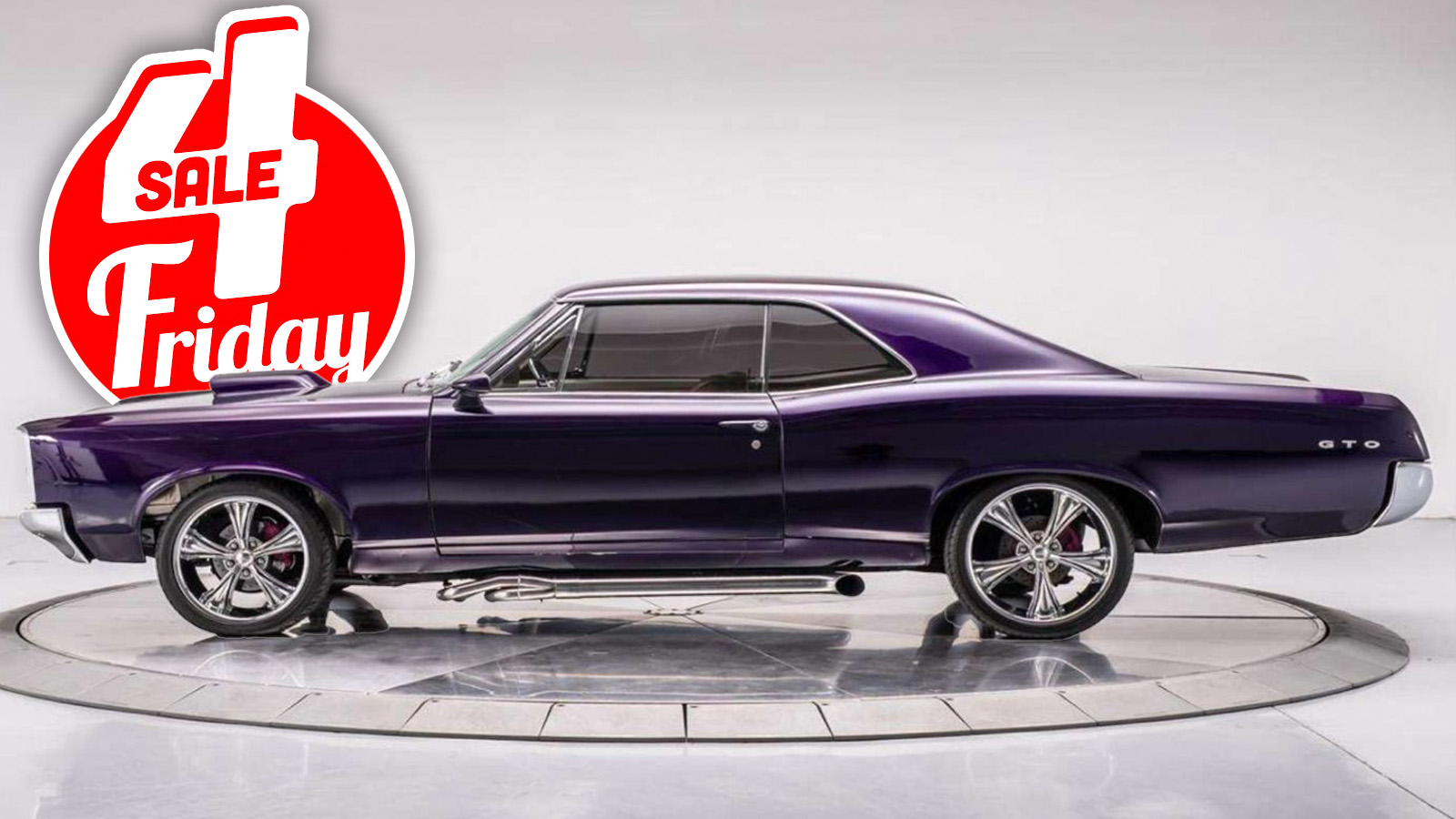
After last week’s Pontiac Pthursday I thought it might be nice to go back to the car that made us all care about Pontiac performance in the first place. The GOAT. Or, if you scramble it a bit, A GTO. It’s not the only car to carry the initials, but it’s the only one you can modify significantly without being accused of heresy or tossing millions of dollars in value out of the window.
While I generally think few cars are truly sacrosanct, customizing a Ferrari GTO - one of the most valuable cars in existence - seems unwise even to me. The Pontiac, though, is fair game. Not only were GTOs modified often in their day, I was at the Greenwich Concours last weekend and there was a whole class of original survivor GTOs, so they’re not so rare as to require special keeping.
Welcome to FOR SALE FRIDAY, a new series we’re testing out where we feature an interesting car for sale in the Galpin Motors universe. We figure we’ve been writing about interesting Cars & Bids cars and Bring a Trailer cars; why not write about our cofounder Beau’s interesting machines? Today it’s a modified 1967 Pontiac GTO.
The name was so legendary that I’m often surprised at how relatively affordable these have become. I think this is another case of the buyers who desired these a few years ago are now largely out of the market. In a world where people are dropping $66,000 for Civic SIs, spending less on a GTO seems like a deal.
A Car That Shouldn’t Exist
 Photo: General Motors
The GTO was an incredibly well-timed car, appearing at a moment when GM both wanted Pontiac to get younger and, yet, didn’t want to be associated with motorsports or the kinds of high-performance vehicles the younger generation wanted. The story of the GTO is well-trod at this point, though it’s worth revisiting just how unlikely this car was given that GM abruptly decided in 1963 that it didn’t want to be involved in racing and put forth a bunch of rules, including ones on putting big engines in small cars.
At the same time, a group of young engineers who would later go on to be famous - John DeLorean and Bill Collins most famously - were tinkering with the idea of putting the brand’s 389 V8 into the LeMans, which was the coupe version of the humdrum Tempest.
As Hagerty writes, once one car was built it created momentum that wasn’t going to end until thousands existed:
DeLorean put some of the most influential players at Pontiac and GM behind the wheel of the new creation. The LeMans test mule was said to be so much fun to drive that DeLorean often had difficulty getting the car back after he had loaned it out. At this point, the biggest obstacle DeLorean faced to get the car into production was GM’s internal policy regarding big engines in small cars: in the GTO’s case, a corporate edict mandating 10 pounds of vehicle weight per cubic inch of engine displacement. The team slyly discovered a loophole in the wording - the displacement limit only applied to base engines; there was nothing written about optional engines. So the LeMans with the GTO option package, which included the 389 V-8, adhered to the rule because it was offered only as an option. DeLorean reached out to Jim Wangers, vice president at Pontiac’s advertising agency, McManus, John, and Adams. DeLorean asked Wangers to promote the sensational car to a whole new generation of young Americans and show them the meaning of driving for fun. Wangers was so successful in promoting the GTO-optioned LeMans that Pontiac took 5,000 dealer orders before the GM Corporate folks knew the car existed. There was no turning back.
I would love to have been in the meeting where DeLorean had to admit he could only build a successful car at GM in secret, and the irony that it was based on the name of a famous race car but sold by a company not involved with racing was surely lost on absolutely no one. DeLorean would obviously go on to become equally famous and infamous and, while the car itself was neither the first muscle car nor the most powerful, it did become one of the most recognizable - due in no small part to the amazing advertising built around the GTO.
GTO, like the Ferrari, gets its name from the term Gran Turismo Omologato, meaning a vehicle homologated to race in the then-FIA GT category. I much prefer the more colloquial version, which is that GTO stands for “Gas, Tires, and Oil” because those are the only things you’d ever need to change.
Today’s FSF car did not follow that dictum and, instead, changed a few more things.
A Plum Crazy 1967 Model
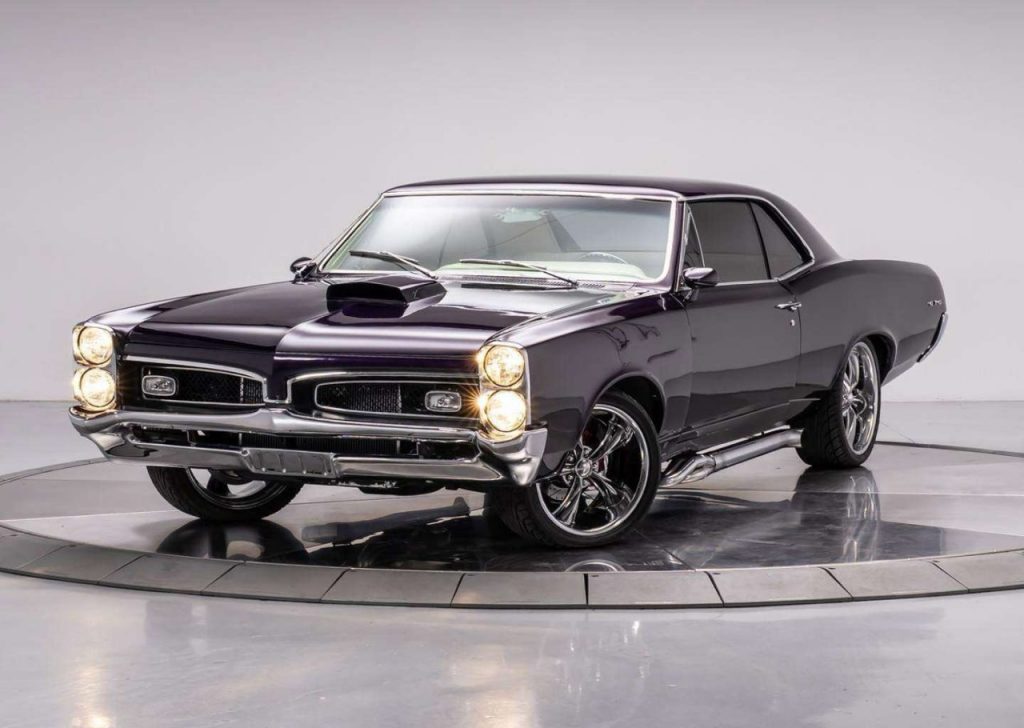 Photo: Galpin Motors
I’m not entirely certain why the 1967 model is the one I immediately picture when someone says GTO. This is the era when most American carmakers were still pushing abrupt visual refreshes to their cars nearly every model year. The 1964 model, though the OG GTO, still hews close to the Tempest LeMans it’s based on and therefore doesn’t stand out visually. By 1965, Pontiac’s success persuaded the company to build an entire brand around the GTO, so the Tempest part was dropped and stacked headlights were added to give the car a little more character. The apotheosis of the first-gen car is also the last iteration, in 1967, where the Coke bottle shape becomes more pronounced and the grille becomes extremely aggressive.
This particular car, for sale at Jaguar Land Rover Van Nuys, has everything possible done to accentuate the shape without ruining the proportions. The Plum Mist Metallic paint is, it appears, a Pontiac color from the era, and is obviously darker than the Plum Crazy I associate with the cult of Mopar. The BOSS wheels, while not stock, are evocative of something you’d find in the era.
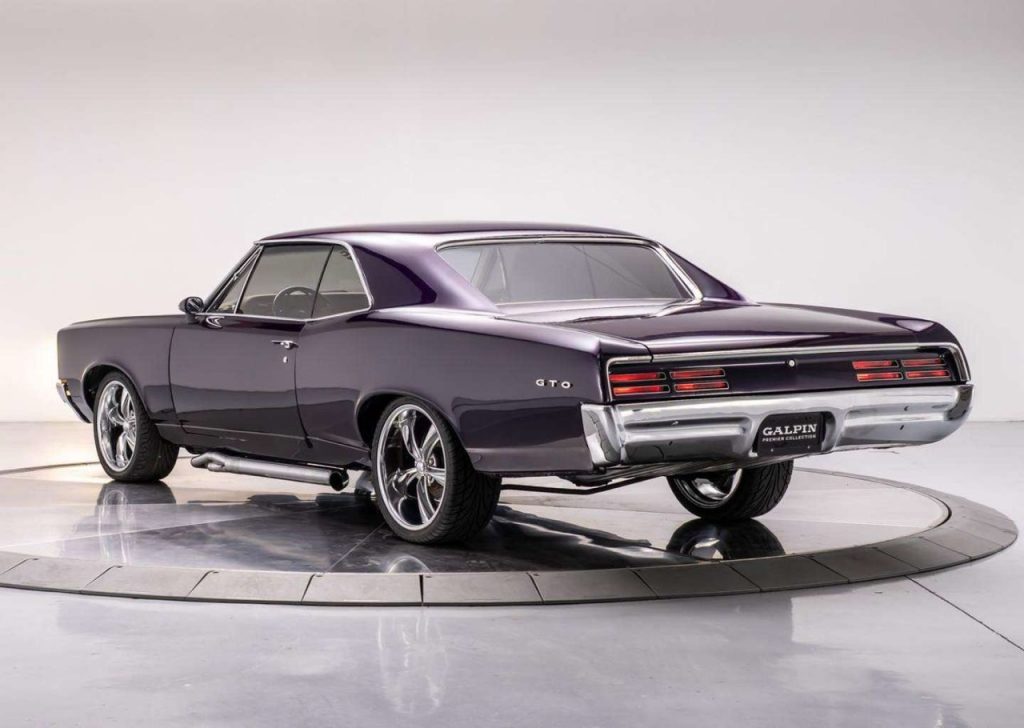 Photo: Galpin Motors
The car looks every bit of its nearly 17 feet of length, with a rear deck roughly the length and flatness of Kansas west of Lawrence. The biggest hint on the exterior that this car is something a little more special than stock are the sidepipes, which fill in the space in the car’s naturally exaggerated wheelbase.
Underhood, things fall into a more predictable pattern:
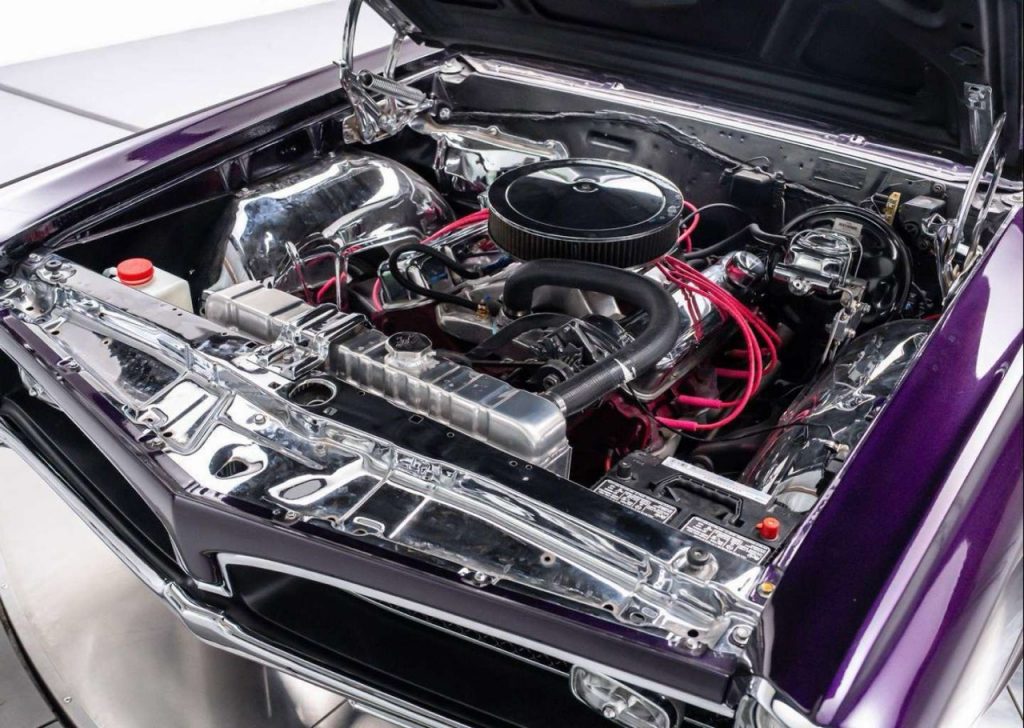 Photo: Galpin Motors
The listing estimates the power at the vehicle’s stock 335 horsepower, which is what most GTOs produced from an evolution of the 389 found in that first model. Do you like chrome? If you want this car, I hope you like chrome, because the inner fenders and just about every reasonable surface ahead of the firewall has a shine to match the wheels.
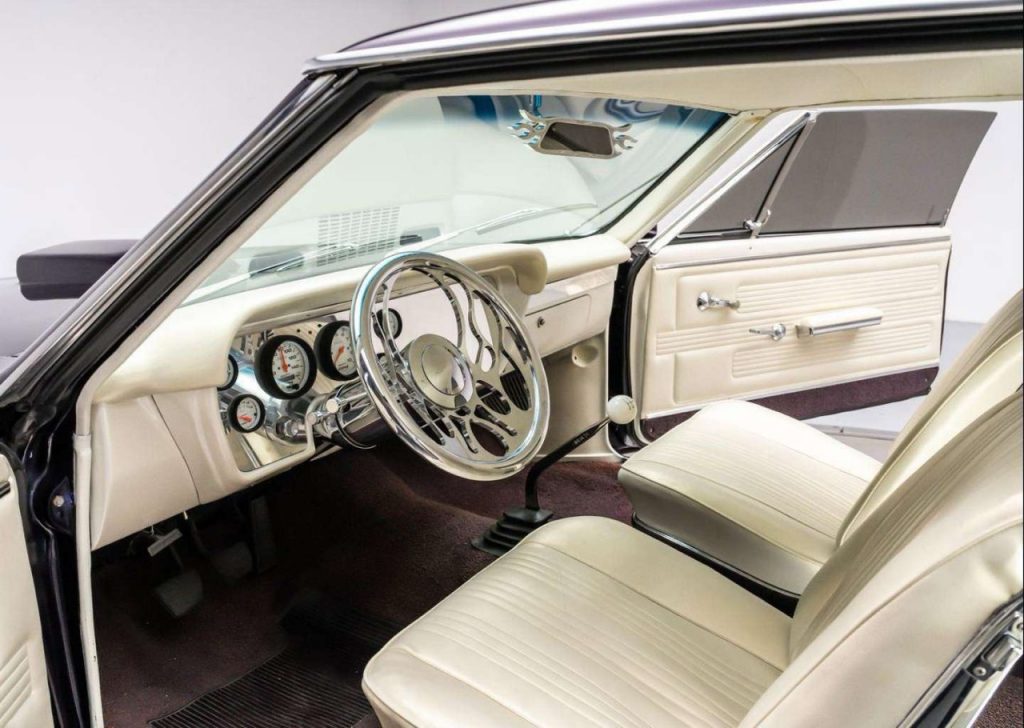 Photo: Galpin Motors
This motif is continued inside, where the car’s 46,844 miles are recorded on the odometer.