
Photo: Andi Hedrick
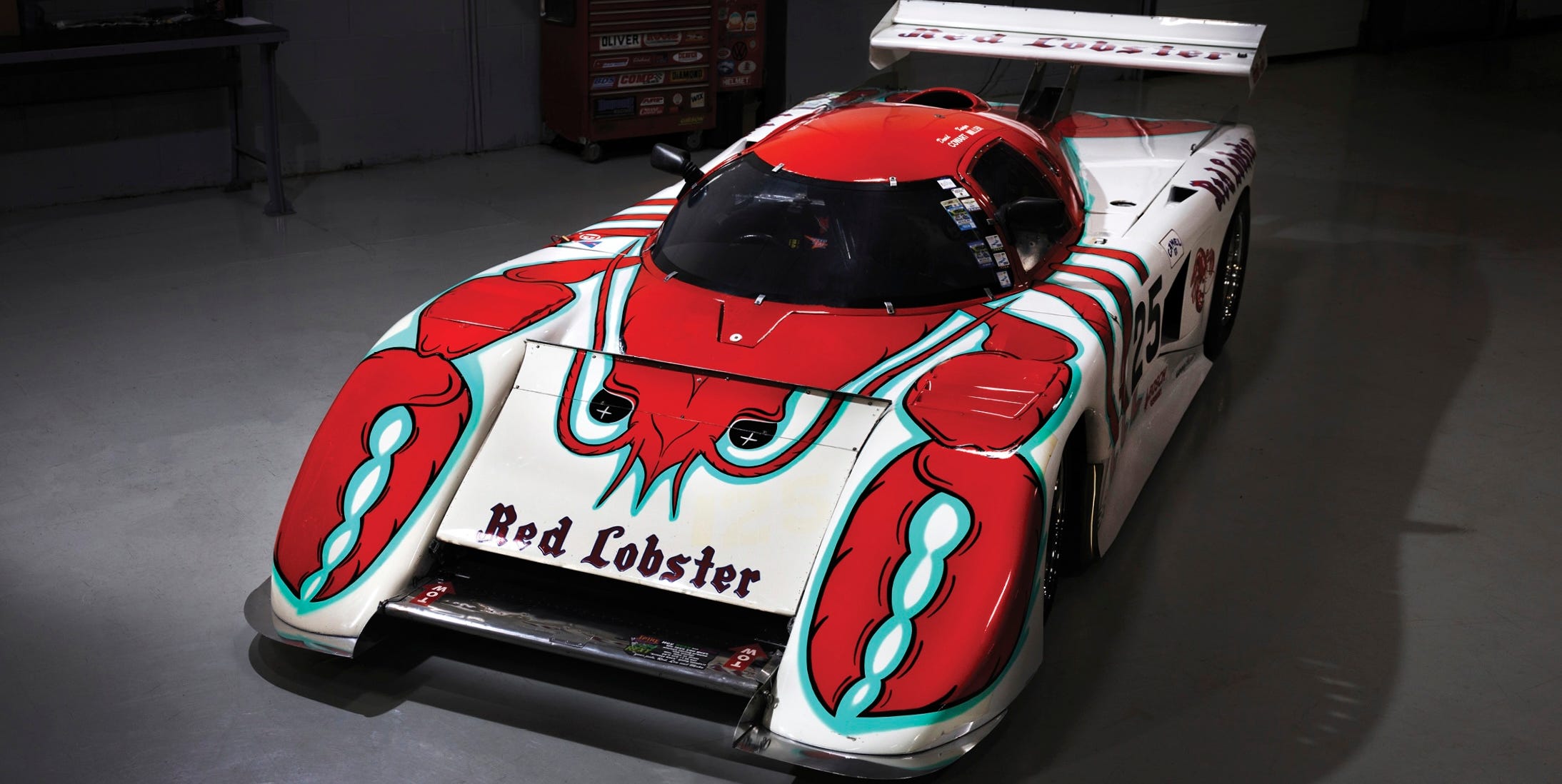
IMSA champ Randy Lanier says, “Seeing those huge claws coming after you in your rearview mirror? Weirdest fucking thing I ever seen.”
Like all of humankind’s best notions - medicine, toffee, harnessing fire - it’s not entirely clear who came up with the proposition of painting an IMSA Grand Touring Prototype (GTP) car to look like a giant lobster.
This story originally appeared in Volume 35 of Road & Track.
But here we are, more than 40 years after that stroke of genius, still thinking about what a perfect idea that was. Yes, how perfectly silly. But also, what a fantastically unexpected hit of dopamine it is to see something fit so perfectly atop another very different thing. The car’s tapered and curved cockpit mimics the crustacean’s segmented shell. The chubby, forward-jutting front corners look like lobster claws even before the pattern goes on. “It was almost as if the car was designed for the livery more than the livery was designed for the car,” says Stephen Bach. A freelance artist who occasionally illustrated Red Lobster and Olive Garden menus in the Eighties, Bach was the man hired to lay out the roughly 15-foot-long decapod onto the body panels in grease pencil.
Ask anyone who was even vaguely aware of IMSA racing in the early Eighties, and they will remember the lobster car. They may not have a clue that the big-lobster livery was first used on a March 82G GTP car. And they won’t know that it arrived at its final form atop a March 83G (pictured here), a highly competitive race car from the brief period of GTP that took place before serious factory spending began. Further, fair-weather fans wouldn’t know that the March 83G was developed to be the early GTP class’s dominant car in part by legend Al Holbert. And such people didn’t necessarily know whose car the lobster was either.
Dave Cowart, who co-drove the Chevy-powered Red Lobster March 83G with Kenper Miller beginning in ‘83, says, “Nobody had any idea who drove it. But they’d scream, ‘Hey! There’s that Red Lobster car!’”

But if the livery overshadowed the people behind it, it was a dream come true for the purveyor of seafood and hush puppies. Red Lobster “felt they got their money’s worth,” Cowart says. If the car were conceived today, the team’s merch game would kill.

Photo: Andi Hedrick - It’s uncanny how perfectly lobster-like the upper body is.
Cowart had a sponsorship deal with Red Lobster starting years before the 83G. He was the IMSA GTO champ in a Red Lobster–sponsored BMW M1. That Giorgetto Giugiaro–designed, sharp-edged sports car was not a suitable canvas for a biomorphic livery, so it ended up with more modest Red Lobster script on the sides and checkerboard stripes. When Cowart moved up to the newly formed GTP class with Miller, it was Red Lobster’s money that paid for much of the dramatically increased cost, including the hand-painting of the body and touch-ups after every race. Looking back, Cowart estimates the sponsorship amounted to $250,000 for the ‘83 season, a tidy sum then.

Photo: Andi Hedrick - Current owner George Frey wanted the last of the analog GTP cars: “I didn’t want to have to open a laptop to run the thing.”
That money allowed Cowart and Miller to purchase March 83G-03, a chassis Holbert had driven to two wins early in the ‘83 season. Holbert was eager to run Porsche turbo engines, so he sold the Chevy-powered 03 car to Cowart and Miller. Ironically, Cowart says that at the time, he was fed up with Porsche turbo engines, which he’d tried to use in ‘82. The 82G was designed with a Chevy V-8, so there was no provision for the excessive heat generated by the Porsche turbos. Once, during a driver change, Cowart noticed that the steering wheel seemed too close to the seat. It turned out that the extreme heat had caused the fuel tank behind the cabin to balloon, pushing the seat forward. They had to retire the car from the race.

Photo: Andi Hedrick - The March 83G was the work of a young Adrian Newey.