As I’ve said before, I really don’t believe most automotive conspiracy theories. The notion that General Motors killed trolley cars to sell more buses doesn’t really wash with me, and I don’t think the “Pinto Memo” was the smoking gun some say it was.
Having said that, I do believe that large auto manufacturers are holding back on technology they could give us now, but will wait forever to finally offer. I even have proof: Ford mass-produced an impossibly high-tech motor way back in 1940, yet it took them over fifty years to build an engine with similar specs for an American street car. Talk about stonewalling.
You Call That Advanced?
The new-for-1992 Crown Victoria seemed like a spaceship next to the car it replaced, but the most astonishing thing to us at the time was the 4.6-liter “modular” V8 powering it.
 source: Ford
This was a rather impressive motor for Ford. I remember looking under the hood of a new Crown Victoria and marveling at the Mercedes-like all-aluminum block and heads with single overhead cams, soon to be double camshafts on later versions with four valves per cylinder, as in the Lincoln Mark VIII.
 source: Ford
At the time, I was driving a nine-year-old Panther body with an old pushrod Windsor V8 which, incidentally, was of virtually the same design as the 289 in the 1965 Mustang that brought me home from the maternity ward many years before. Ford seemed to have jumped ahead decades with this new motor into what was for them uncharted territory.
Hardly. Thousands of vehicles had already been built by Ford with an engine not unlike the 4.6 V8, except this earlier twin-cam aluminum V8 was the largest gasoline-powered engine ever produced by Henry’s firm. If you’ve never heard about the Ford GAA, get ready to be shocked.
Just Plane Big
Two situations tend to bring out the most advanced thinking from automakers. One is motorsports competition, and the other is competition of a more dangerous nature: battle for world dominance. World War II saw combustion-engined technology pushed to the limit.
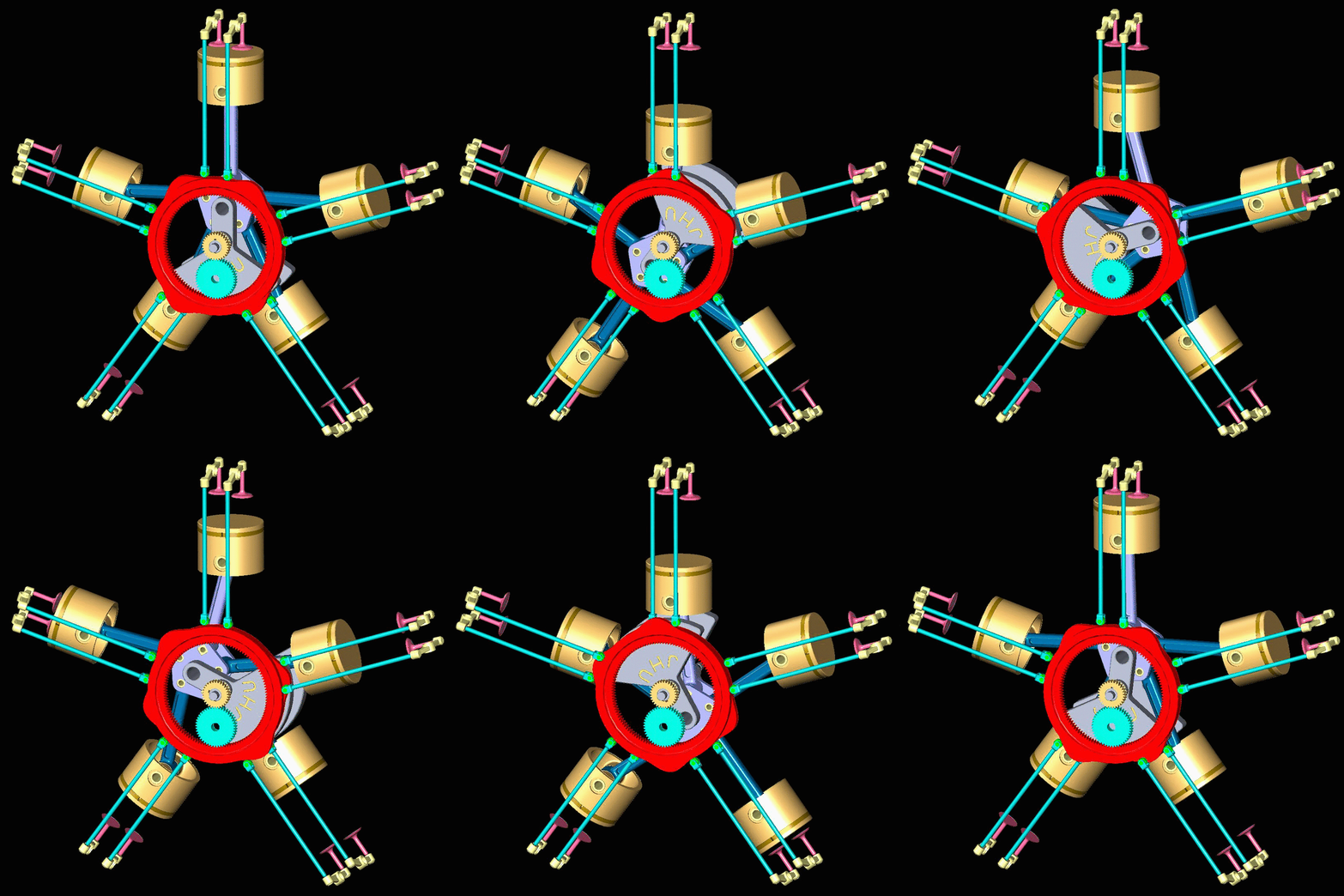
In the early part of the twentieth century, aircraft were primarily powered by air-cooled radial engines with pistons arranged in a circle around the propeller shaft, but this was starting to change.
 source: Wikimedia / Stoionivici
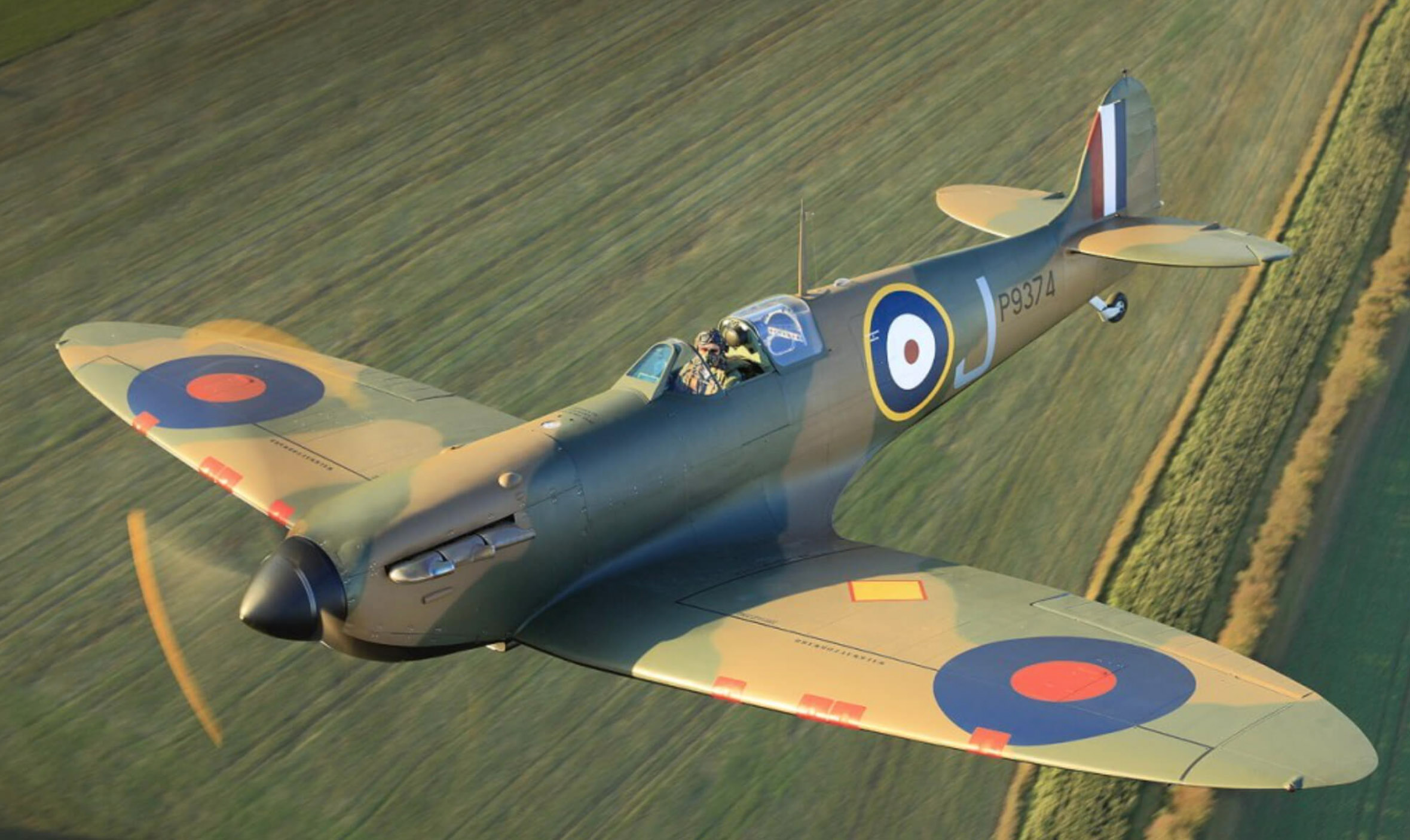
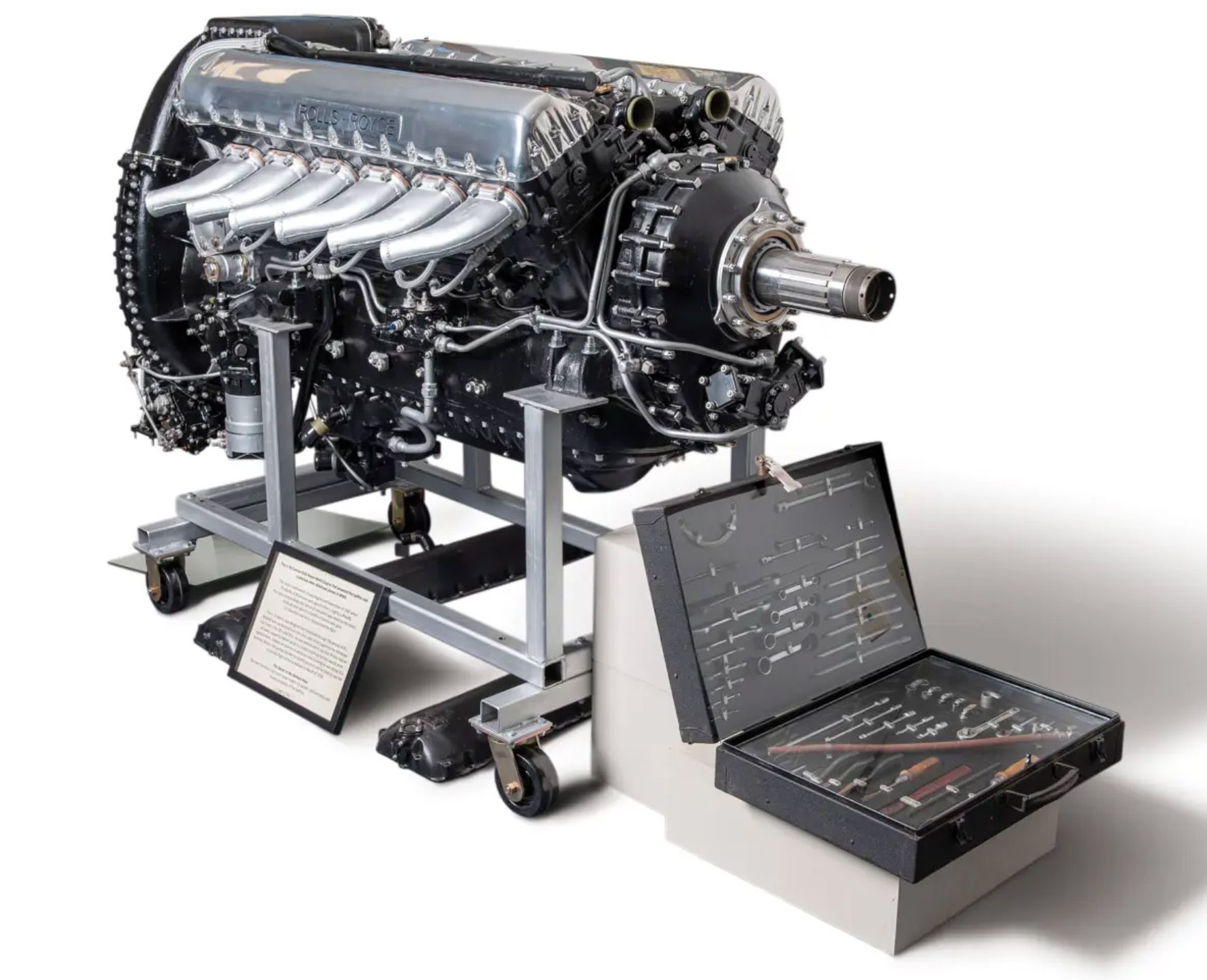
A shift to inline or V-format liquid-cooled engines began with the aircraft that were being developed for what would become World War II. The famous British Spitfire fighters featured a massive 27-liter V-12 called the Merlin, built by then-engine-builder Rolls Royce. Sure, the jets you’ll see in Top Gun are impressive, but if you’ve ever been to an air show and heard a Merlin-powered craft fly over you at low altitude, the noise just stirs your soul; you really feel those twelve cylinders as much as hear them.
 source: Platinum Fighter Sales
England needed help making more of these powerplants from their allies here in the states, and Ford had factories in the UK at the time. During WWII, these Ford factories produced 30,400 Merlin motors in England, but Old Blighty wanted more.
 source: RM Sotheby’s
At the very least, English manufacturers wanted Americans to make complex parts for the Merlin — crankshafts, for example — but they ran into issues. US companies like Packard simply didn’t want to produce anything other than complete engines. Ever-obstinate Henry Ford figured that he’d invented the freaking assembly line and didn’t have any interest in making an engine designed by someone else in a country we had declared independence from. Besides, he saw this as an opportunity to get into the aircraft engine market himself. In retrospect, he probably should have done some homework first.
Ford Motor Company went down a path to develop a motor that was very similar to the Merlin. Named the XV-1650, this 60-degree liquid-cooled V-12 displaced 1,650 cubic inches and was packed with technology that was mind-blowing for the time: aluminum block and heads, dual overhead camshafts, and four valves per cylinder. Contemporary reports said the so-called Merlin copy was anything but; it was actually modified and ostensibly improved in every way over the British engine. Ford was convinced that this would be the ideal powerplant for not just military but civilian aviation moving forward.
 source: Ford via Mac’s Motor City Garage
Henry Ford being Henry Ford, he proceeded with this work without checking to see that the contracts the US government had with other manufacturers were rather ironclad and protracted, meaning all of this work was seemingly for nought. Or was it?
Tanks A Lot
Despite being spurned by the aircraft makers, Ford went back to what he did best: ground-based vehicles. In an odd turn of events, there was a need for the Ford aircraft engine, or at least half of it. Hard to believe, but the then-current M4 Sherman tanks were powered by the Wright R975 Whirlwind: a 9-cylinder radial engine.
 source: Wikimedia / Joost Bakker
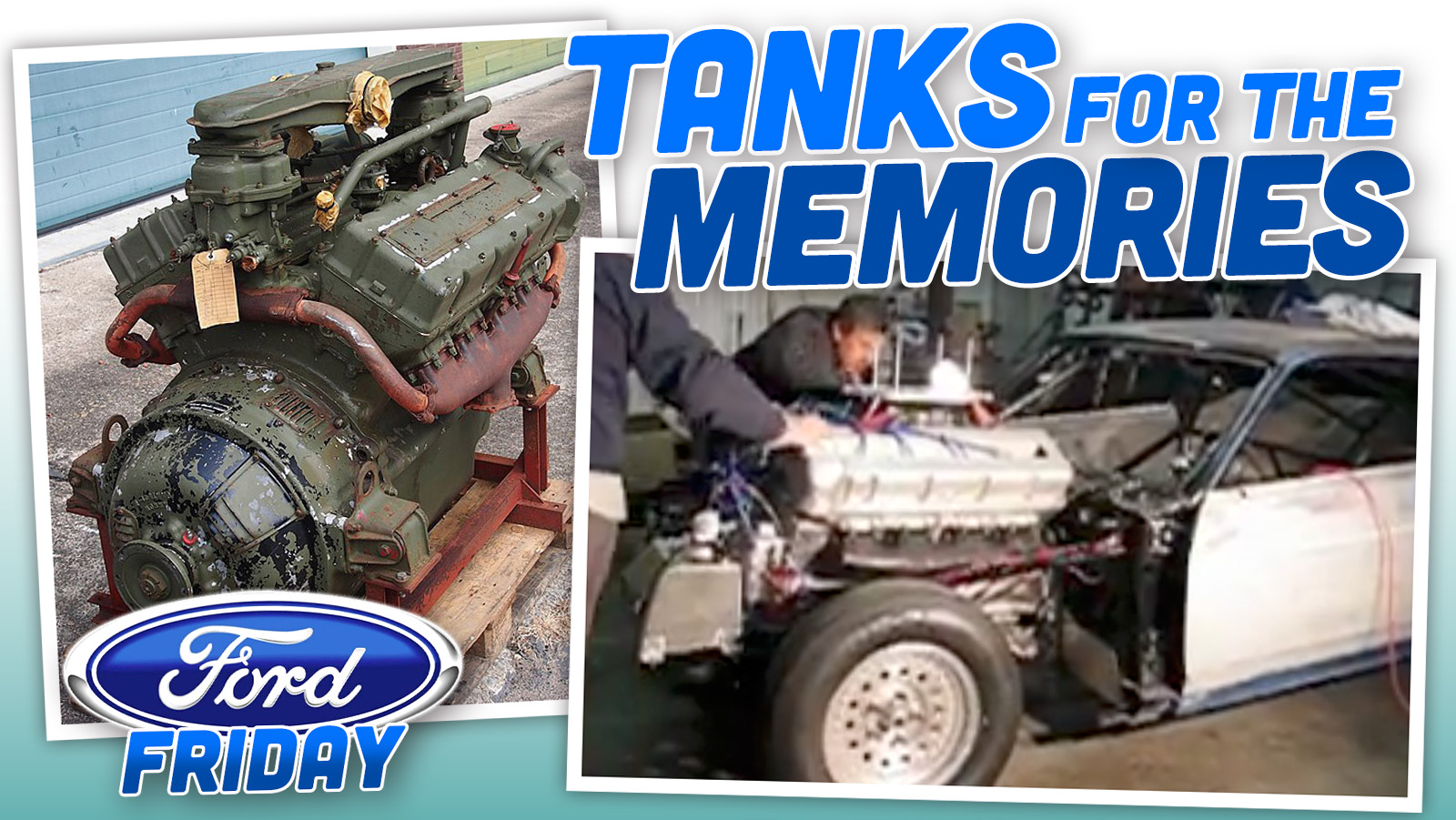
Supply issues with the Whirlwind sent the Army looking for additional providers, and Ford had an idea. The XV-1650 was too large for the application, so they chopped four cylinders off to create a huge V8 — what would become the Ford GAA: an 18-liter, 32-valve, quad-cam aluminum V8 producing around 500 horsepower. With dual ignition systems providing two spark plugs per cylinder for reliability in the field, it was among the most technically sophisticated engines Ford had ever built. The GAA went on to power tens of thousands of Sherman tanks through the remainder of the war, proving that Ford had been sitting on genuinely advanced engine technology for decades before any of it trickled down to an American passenger car.
That fact alone makes the 1992 Crown Victoria’s celebrated 4.6-liter DOHC V8 feel a little less revolutionary — Ford had already been down that road, in a tank, fifty years earlier. And as for the Mustang connection: at least one ambitious enthusiast looked at the GAA’s compact-for-its-displacement footprint and decided it belonged under a pony car’s hood, a notion that is equal parts brilliant and completely unhinged — which, when you think about it, is exactly the spirit the Mustang was built on.