Hyundai’s Next Wave Is Bigger Than It First Appears
Coming off record sales in 2025, Hyundai isn’t planning a quiet 2026. The Korean automaker has at least five models either refreshed or entirely reimagined for the 2026 and 2027 model years - a mix of styling updates, powertrain additions, and at least one technology direction that puts Hyundai a step ahead of most competitors in its segment. The scope of changes runs from minor cosmetic work on the Elantra to something genuinely significant on the Santa Fe.
What makes this slate interesting isn’t just the number of vehicles involved. It’s that Hyundai is clearly pushing two distinct agendas at once: making its electric options more accessible, and giving buyers who aren’t ready to commit to a full EV a credible, practical alternative. The EREV Santa Fe is the sharpest expression of that second goal.
Elantra: Familiar Formula, Small Revisions
The Elantra is due for a mid-cycle refresh, though Hyundai isn’t expected to rethink the car from the ground up. Changes should focus on the nose and tail - updated sheetmetal and lighting rather than a structural overhaul - along with a revised interior layout. It’s the kind of update that keeps a competitive compact sedan current without alienating existing buyers.
Powertrain options for the standard Elantra are expected to carry over unchanged. Given where the Elantra currently sits in the compact sedan market, that’s a defensible call. The more intriguing possibility is a new engine variant for the Elantra N, though nothing has been confirmed.
Whether the Elantra N gets a new powerplant or simply rolls into the new model year with the existing setup, the refresh should be enough to keep the sedan competitive against the Honda Civic and Toyota Corolla through at least 2027.
Ioniq 3: The One That Won’t Cross the Pacific
Hyundai’s Ioniq 3 is a compact electric hatchback with a claimed range exceeding 300 miles. On paper, it answers a real question in the EV market: what do buyers do when they want reasonable range without paying for a larger vehicle? The Ioniq 3 packages that answer into a small, presumably affordable form factor. The problem, at least for American buyers, is that Hyundai has no current plan to sell it in the United States.
That absence is hard to justify when the average new car price in the US continues to climb and fuel costs remain a genuine household concern. EV demand has softened from its peak, but it hasn’t collapsed - and a well-priced, long-range compact EV would find buyers in markets where charging infrastructure is reasonably established. For now, the Ioniq 3 looks like a missed opportunity for the American market.
Kona: Production Pause, Then a Bigger Comeback
Hyundai paused Kona EV production for the 2026 model year after 2025 inventory ran higher than anticipated. Rather than flood the market, Hyundai pulled back. That restraint may pay off if what follows is genuinely worth the wait.
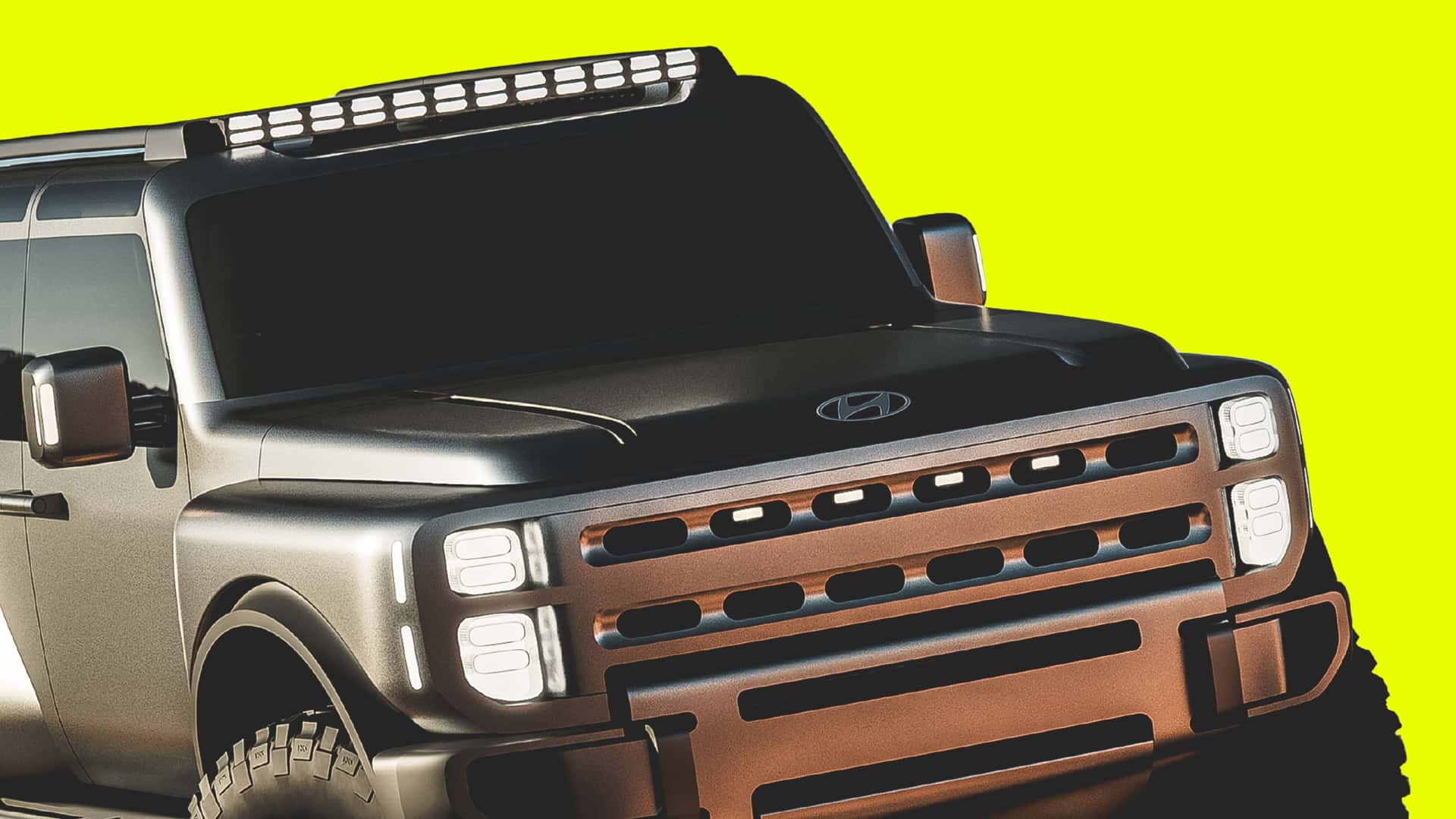
The 2027 Kona is expected to arrive as a full redesign rather than an incremental update. The design direction is described as a tougher, more upright stance - consistent with the broader shift across Hyundai’s CUV and SUV lineup toward squarer, more geometric proportions. This aligns with the aesthetic Hyundai introduced with the Crater concept.
Powertrain options for the 2027 Kona are expected to include a turbocharged 1.6-liter hybrid and a revised EV version. Both variants should come with Hyundai’s latest cabin technology, which has been steadily improving across the model range. The combination of a bolder exterior and updated interior would represent the most significant Kona evolution since the current generation launched.
Santa Fe: The EREV Arrives
This is the model that deserves the most attention in Hyundai’s 2026–2027 cycle. The 2027 Santa Fe is expected to offer an extended-range electric vehicle powertrain - a configuration that operates on electric motors and a battery pack under normal conditions, but carries an onboard combustion engine that functions exclusively as a generator when the battery runs low. The driver can charge the battery conventionally, or simply fill the fuel tank and let the engine replenish the battery on the move.
The closest reference point most buyers will recognize is the Chevrolet Volt, which used an identical architecture before GM discontinued it. An EREV Santa Fe would offer an estimated total range of around 560 miles - a figure that addresses the range anxiety argument more directly than most plug-in hybrids, which typically run their combustion engines in a more conventional parallel configuration.
Hyundai has been investing heavily in its Georgia Metaplant, and the Santa Fe EREV is understood to be among the vehicles planned for assembly there. For buyers who have been sitting out the EV transition because they don’t want to depend entirely on charging infrastructure, an EREV with 560 miles of combined range offers a concrete reason to reconsider.
It’s worth pausing on that number.
A 560-mile total range in a midsize family SUV - achieved through an architecture that requires neither a massive battery pack nor a full commitment to EV charging - positions the Santa Fe EREV against vehicles like the Toyota RAV4 Prime and Ford Escape Plug-In Hybrid, both of which rely on parallel hybrid systems with far shorter electric-only ranges.
Tucson: Two Decades In, Still Evolving
The Tucson has been a fixture in Hyundai’s lineup for twenty years, and the compact SUV is due for another update as it moves into the 2027 model year. The expected redesign follows the same boxier direction as the Kona, with a more angular exterior while preserving the lighting elements and design language that have become recognizable across the current Hyundai family.
Hybrid and plug-in hybrid variants are expected to continue for the 2027 Tucson - both have been strong sellers and Hyundai has little reason to abandon either. There’s also discussion of a Tucson N performance variant arriving at some point, though the timeline for that version remains unclear. The Tucson N would join an expanding performance sub-brand that already includes the Elantra N and Kona N.
The Tucson update is perhaps less dramatic than the Santa Fe’s EREV development, but it matters commercially. The compact SUV segment is among the most contested in the American market, and a well-executed redesign with a strong hybrid option keeps Hyundai in direct competition with the RAV4, CR-V, and Escape at a volume that shapes the brand’s overall sales figures.
What This Lineup Says About Hyundai’s Direction
Reading across these five vehicles, the pattern is reasonably clear. Hyundai is not abandoning electric vehicles - the Ioniq 3, the Kona EV update, and the Santa Fe’s electric-capable EREV architecture all confirm that. But the brand is also acknowledging that the path to EV adoption is longer and more complicated than it looked in 2021 and 2022, and it’s engineering products for buyers at multiple points along that path.
The Santa Fe EREV is the clearest signal of that thinking. An onboard generator that runs on regular gasoline, a total range of around 560 miles, and the ability to charge at home or at a station - that configuration costs Hyundai more to engineer than a standard hybrid, but it potentially converts buyers who would otherwise have stayed with a conventional powertrain entirely. Whether the starting price lands at a level that makes that calculus work is the question that won’t be answered until Hyundai puts an actual window sticker on the vehicle.