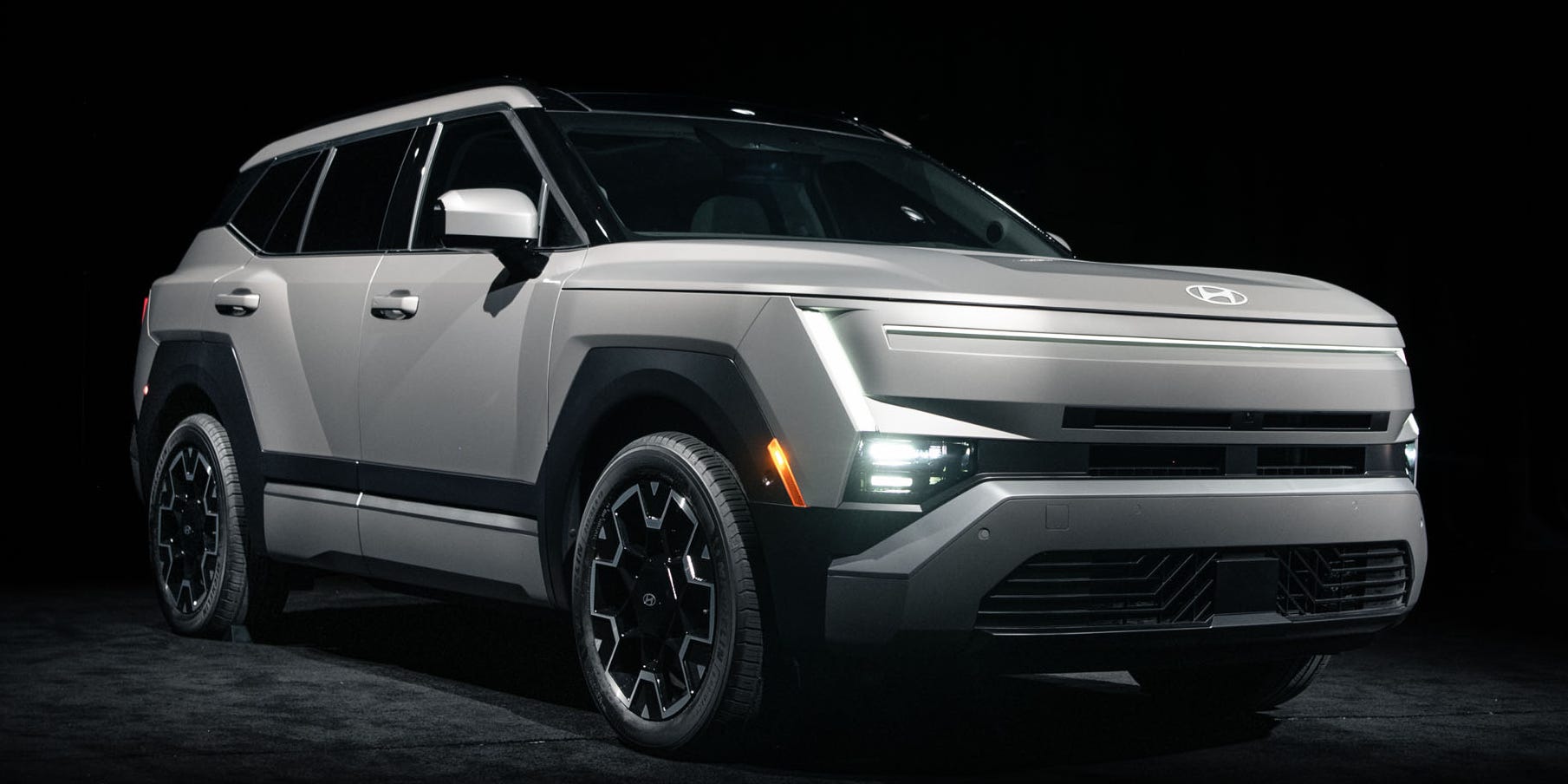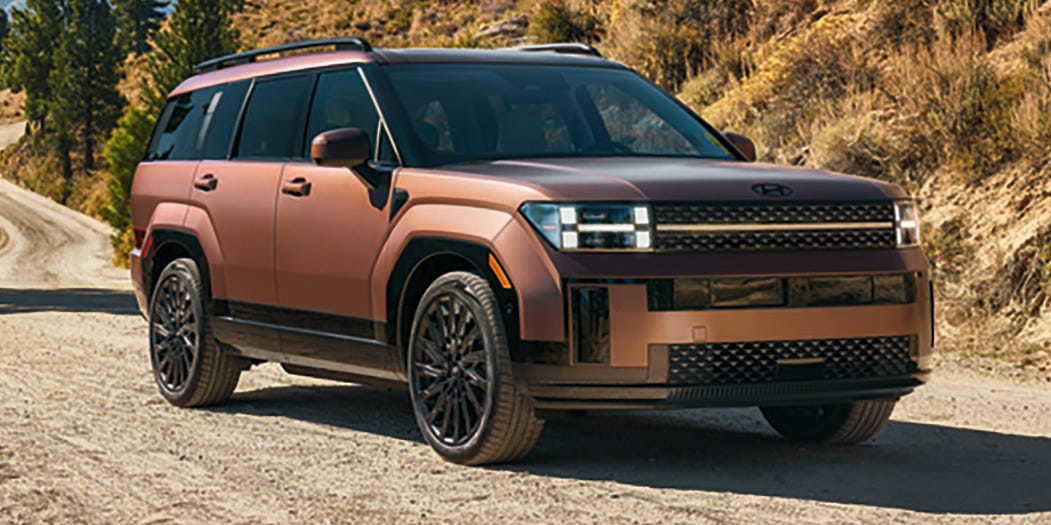

HIGHS: Futuristic rectilinear exterior, class-competitive fuel economy, well-equipped for the price.
LOWS: Doesn’t enjoy hustling, tiny third row, slower than its non-hybrid sibling.
VERDICT: Underneath that stubbornly cubist styling lies an efficient, well-equipped, family-friendly SUV.
Overview
The Hyundai Santa Fe Hybrid may look like it’s from the future, but it’s very much a real-time, three-row family SUV that makes a lot of sense for today’s drivers. The hybrid powertrain, comprised of a turbocharged 1.6-liter four-cylinder teamed with an electric motor for a combined 231 horsepower, funnels output through a six-speed automatic transmission and a choice of either front- or all-wheel drive. Fuel economy hovers in the mid-30 mpg range for both city and highway driving.
The interior follows the exterior’s rectilinear theme, with comfortable seats bisected by an XL console. The combination instrument and infotainment screen is angled towards the driver, and a majority of the primary controls are located on the center console for ease of use. Access to the third row is streamlined, but legroom will be a concern for taller passengers.
Expert Tip: The non-hybrid Santa Fe is only marginally less expensive, but its 6.9-second run to 60 mph is nearly one second quicker than the hybrid’s 7.8-second time, both as measured in C/D testing.
What’s New for 2027?
The Santa Fe Hybrid rolls into 2027 with only minimal changes.
Pricing and Which One to Buy
Pricing details to be updated as information becomes available.
Engine, Transmission, and Performance
- Hybrid Powertrain: Turbocharged 1.6-liter four-cylinder and one electric motor, 231-hp combined
- Transmission: 6-speed automatic
- Drivetrain: Front-wheel drive or all-wheel drive
All Santa Fe Hybrids are powered by a turbocharged 1.6-liter four-cylinder, assisted by an electric motor for a combined 231 horsepower. That’s a little more powerful than the 226-hp setup offered in the previous-generation model. In the real world, acceleration is sufficient for the casual driving most buyers of three-row crossovers will do, but the Santa Fe occasionally feels sluggish when merging or passing on the highway. The Santa Fe Hybrid’s road manners are subdued, the ride is comfortable, and engine noise is well-isolated from the cabin unless you’re really hustling. All models come with a six-speed automatic transmission; front-wheel drive is standard and all-wheel drive is optional.
0–60 MPH Times
- C/D 60-mph Test: 7.8 seconds
In Comparison: Though the base 245-hp Grand Highlander Hybrid is a closer competitor to the Santa Fe Hybrid, Toyota’s available 362-hp Hybrid Max model knocked off the 60-mph run in just 5.6 seconds in C/D testing. The nonhybrid Santa Fe is also quicker than the hybrid, reaching 60 mph in 6.3 seconds.
Towing and Payload Capacity
- Max Towing: 2,000 pounds
The Santa Fe Hybrid is rated to tow 2,000 pounds. If towing is in the game plan, the nonhybrid Santa Fe XRT is a better fit, as it’s rated for up to 4,500 pounds.
In Comparison: The Toyota Grand Highlander hybrid can tow up to 3,500 pounds in base form and 5,000 pounds with the Hybrid Max powertrain, though greater towing capacity requires spending more.
Fuel Economy and Real-World MPG
- EPA City Ratings: 35–36 mpg
- EPA Highway Ratings: 34–35 mpg
The EPA estimates that front-wheel-drive Santa Fe Hybrids return 37 mpg city, 36 mpg highway, and 36 mpg combined. All-wheel-drive models earned ratings of 35 mpg city, 34 mpg highway, and 34 mpg combined.
Real-world highway fuel economy test results will be added once C/D testing is complete.