From the July/August 2026 issue of Car and Driver.
At some point, hopefully not too recently, you were probably eating a lot of dirt and regularly filling a diaper. But look at you now: a responsible adult with a grown-up job, only incidental earth in your diet, and mostly clean underwear, shepherding the next generation of soil gobblers into the vibrant and fragrant tapestry of life.
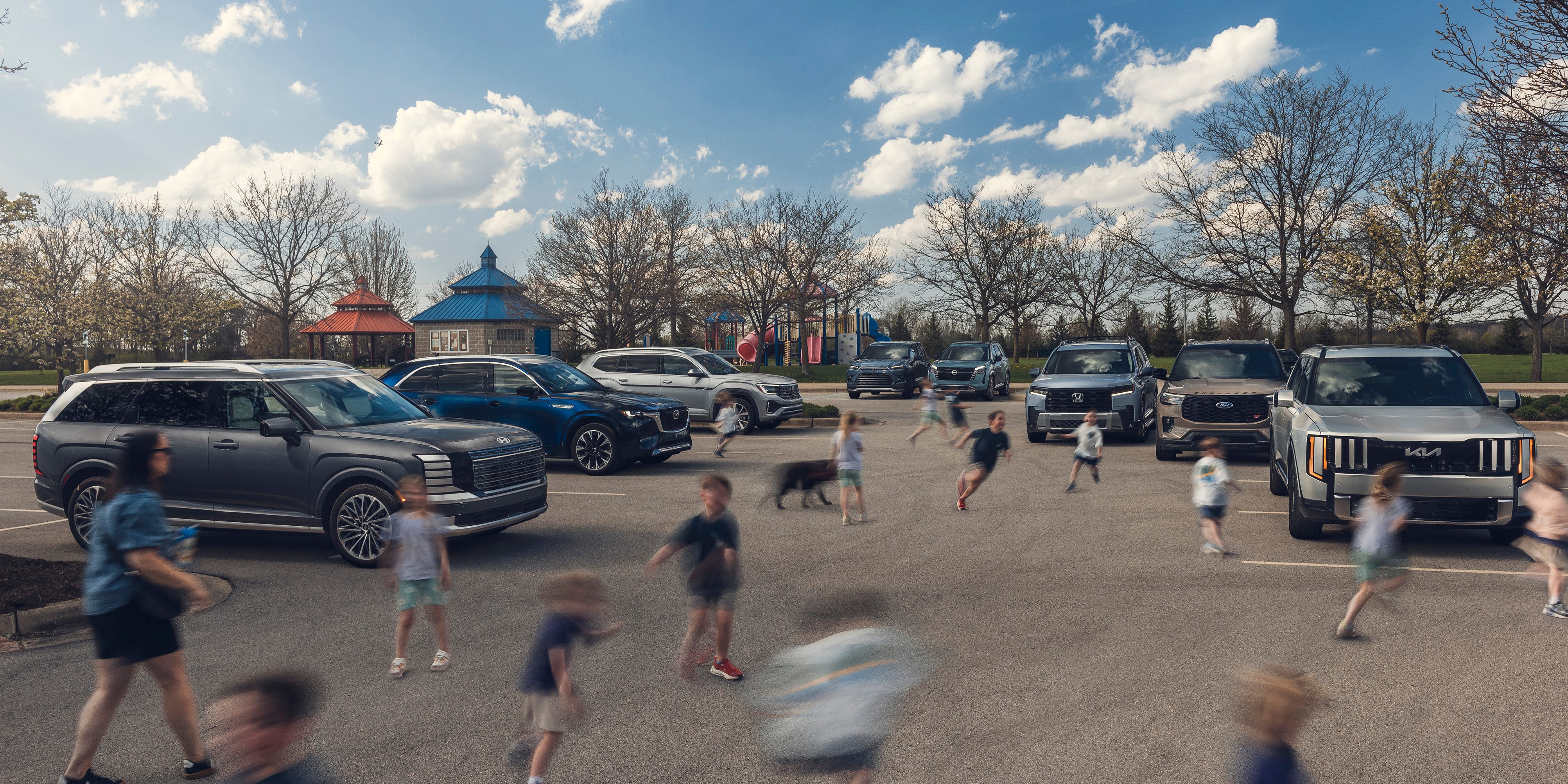
If you’re shopping for a three-row SUV, odds are it’s because you have a passel of children. All the SUVs gathered for this comparison have base prices in the neighborhood of $40,000 to $45,000, but the examples tested here all represent the pinnacle of their kind — exactly what parents hope their children will be. Priced from the mid-$50,000s to the high $60,000s, every one is an awful lot of car for around 20 percent more than the average purchase price of a new vehicle. This is likely the greatest number of heated and ventilated seats, the most sunroof square footage, and the largest cumulative area of touchscreen we’ve ever gathered in one comparison test.

The winner here is going to be the vehicle that keeps the kids happy and Mom and Dad sane. Maybe it’ll even give them something new to love. (Meaning the vehicle, not another kid. Our HR policy forbade us from testing these vehicles’ suitability for the creation of new humans.)
8th Place: Nissan Pathfinder
The oldest nameplate in this group, the Pathfinder was once a rudimentary body-on-frame off-roader with a much more appropriate appellation. Now that Nissan’s ProPilot Assist hands-free driving tech is standard, maybe they ought to start calling it the Pathfound.
The Pathfound sticks with what works, packing one of just two naturally aspirated V-6s in this test. Generating 284 horsepower and 259 pound-feet, Nissan’s 3.5-liter is a single horsepower and three pound-feet behind Honda’s. It has the highest tow rating here, but the word “gutless” appears twice in the Pathfinder’s logbook and zero times in the slower Pilot’s. The pleasant soundtrack of the latter distracts drivers from its sloth, while the Nissan’s slow-witted transmission grants extra time to focus on the engine as it reaches its most coarse.
Otherwise, numbness is the overriding impression from the driver’s seat of the Pathfinder: numb steering, numb brakes, and a gas pedal that feels like stepping into lake-bottom muck. Things happen in reaction to these inputs, but to what degree, how rapidly, or how much resistance there is to them is anyone’s guess.
And actually, maybe Pathfinder is still an apt descriptor. The Nissan meanders so much on the freeway that we first assumed we were battling extreme crosswinds. But the grass and trees alongside the highway were dead still, and nobody in the other vehicles noticed any meaningful wandering. Every subsequent driver climbed out of the Pathfinder equally stunned to see no livestock soaring by on the wings of a spring tornado. A comfort-oriented, family-friendly three-row SUV is a weird place to encounter tramlining this bad. “Head toss” is another recurring phrase in the Pathfinder’s logbook, scribbled by three of our eight drivers. One mentioned a “little bit of whiplash,” and another likened driving the Nissan on winding roads to being in a mosh pit.

The Pathfinder’s cabin — a mix of chestnut leather, black plastic, and unconvincing fake wood — does boast the airiest front seat, and the consensus was that it had one of the most comfortable third rows with adults packed three across. But no seats were actually comfortable, and in their likelier second-row habitat, grown-ups will find headroom rather limited.
HIGHS: Space and comfort from first to third rows, highest towing capacity by half a ton. LOWS: Oh, boy. Where to begin? VERDICT: If you absolutely need to tow 6000 pounds, used Chevy Tahoes are readily available.
Director of vehicle testing Dave VanderWerp summed up the Nissan, writing that it “is missing the last 5 percent of polishing that the best vehicles have.” Many of the right pieces are here, but few are fully integrated or polished, leaving the Pathfinder feeling like a collection of parts rather than a cohesive whole.
7th Place: Mazda CX-90
Mazda debuted the CX-90 for 2024 to replace a perennial Car and Driver favorite, the CX-9, and did a lot more than just multiply the name by 10. A longitudinally mounted turbocharged inline-six sends torque through an eight-speed automatic to all four wheels. In Turbo S tune and burning premium fuel, the 3.3-liter puts out 340 horsepower and 369 pound-feet, making it an early favorite based on specs alone, and the Mazda’s sultry shape is heavily preferred by the eyes. There’s even real wood trim inside. The low driving position also engenders ready affection, with an intimate relationship between driver and controls. The steering follows directions but is a bit slow. The C/D reader should know that the CX-90 will rotate under trail braking — but what the hell are you doing thinking about that with kids aboard?

Get your priorities straight. Ride quality is what matters here, and the Mazda’s is the worst in this group. On bumpy roads, the wheels chop like Gordon Ramsay’s knife slicing carrots. Even on smooth pavement, the second-row headrests shake so violently that we aimed the rearview mirror at the seatback to minimize the distraction.
The upside to this stiffness is nonexistent: Compared with the Hyundai Palisade, which we judged to have the smoothest ride here, the Mazda stops from 70 mph a single foot farther and hangs on for 0.01 g less on the skidpad. That’s not what we’d call a good ride and handling compromise.
While Porsche has conditioned us over the last 34 years to expect seemingly impossible performance from anything with a Turbo S badge, this is not that. The CX-90 is quicker than most of the competitors here but loses the drag race to a freakin’ hybrid Toyota — not to mention the hot-rod Ford. Nor does the CX-90 deliver on the auditory promise of its engine layout. It is the noisiest powerplant here under wide-open throttle, but it warbles unsexily, it shifts well before its 6500-rpm redline, and a whine had one editor clarifying with his colleagues that it is not, in fact, supercharged. The inline-six and eight-speed automatic did deliver the best fuel economy in our 75-mph highway test at 29 mpg, which is the kind of efficiency that makes a long family road trip measurably less painful at the pump.