From the December 1996 issue of Car and Driver.
Here’s great news for those new-car buyers trying to scrape by on 50 large. The ready-to-drive rack is groaning with the season’s latest fashions, and most of them are all new within the past few months. Sounds like the call for your obedient servants to slip into their calibrated, thin-seat trousers and head for the secret test roads, doesn’t it?
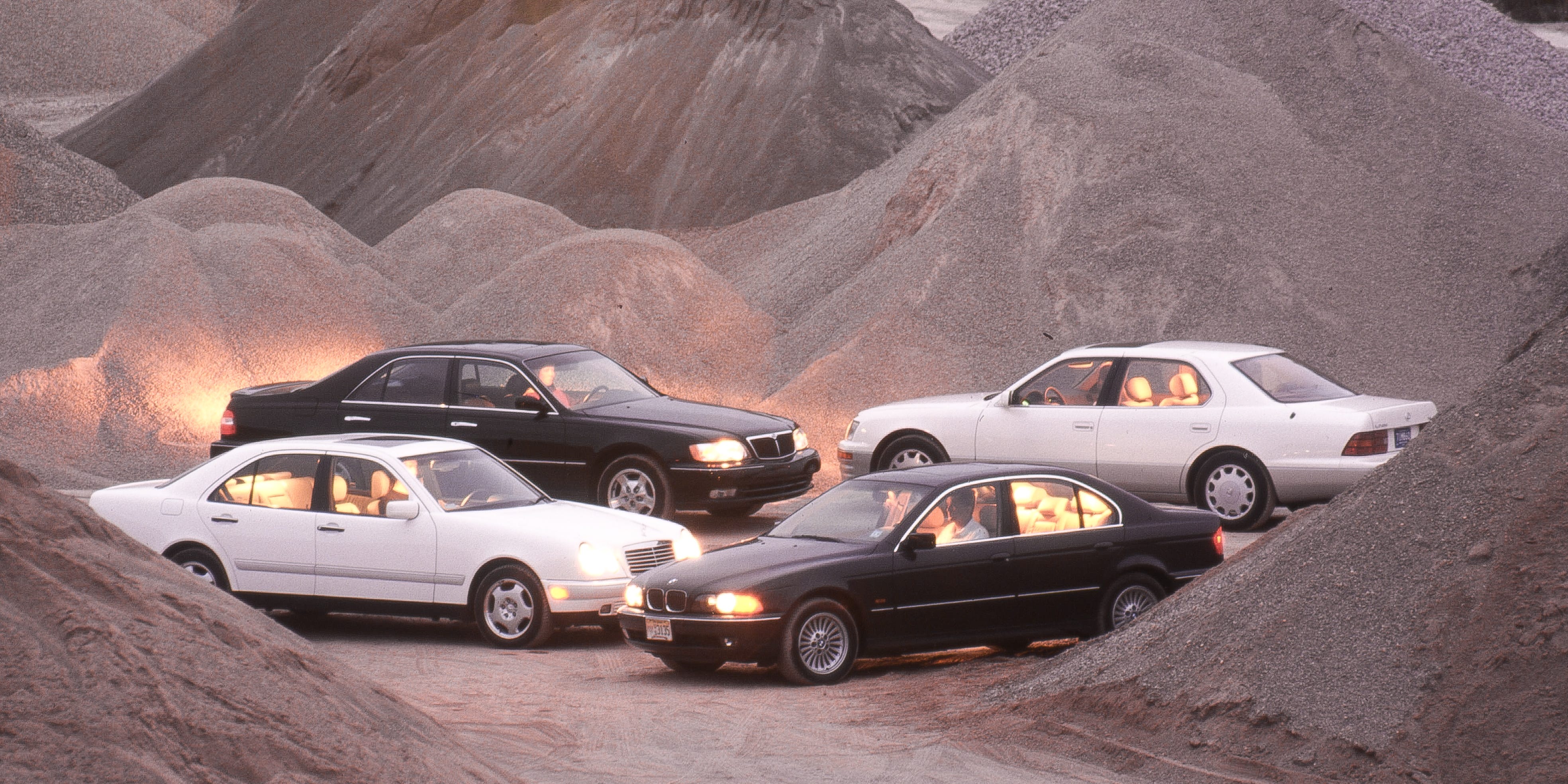
The fresh faces here are the BMW 540i, the Mercedes-Benz E420, and the Infiniti Q45t. In the latter case, Nissan has jacked up the familiar Q45 badge and driven an all-new sedan underneath. The original Q, you may remember, came confidently into the luxury market as a 1990 model thinking the customers would be won by horsepower instead of dashboard wood. They weren’t. For 1997, a chastened Infiniti’s second try for those customers crams an all-you-can-drive smorgasbord of luxury-car cues into a body cautiously styled to avoid offending anyone.
This retargeted Japanese entry faces two Germans that you might recognize as V-8 versions of the six-cylinder sedans that placed first and second in our “Semi-precious Metal” comparison (C/D, August 1996). These two cars reflect a European approach to midrange luxury that’s quite distinct from the Japanese way and from the American way. These are downright compact four-doors with the sort of sinewy chassis muscles that activist drivers enjoy. Those who enter through the three other doors are carried as tourist-class passengers and are encouraged to keep quiet if they can’t say something nice. You will notice, though, that this magazine is staffed by test drivers, not test passengers, so the European way usually gathers the most votes.
Usually. But readers of above-average RAM may recall our luxury sedan comparison (C/D, February 1995), in which the second-generation Lexus LS400 made its debut by outscoring all comers in a group priced about like this one. That Lexus stands as a luxury-car benchmark—an outstanding combination of comfort, silence, power, fuel economy, and roominess. As it rolls into its third year of sales, the price remains about where it was ($55,141 base for 1997). Can this proven Lexus formula still whup the Europeans? Comparison tests were invented to answer such questions.
Any other candidate out there? The Cadillac STS has just enjoyed a substantial price cut for 1997, dropping it well below the 50-large mark. And we see no other possibilities. So let the ratings begin.
4th Place: Infiniti Q45t
After a few seasons at their craft, car testers, like wine tasters, learn to read their subjects very quickly—the first 10 miles fills in most of the picture. But not in this Infiniti. The flavors are too subtle, they build too slowly. It’s more delicious on the second day, and better still on the third. What seems at first to be a big, silent, indecisive saloon turns into, after some hours, a self-effacing machine with an inherent poise that lets you cover the miles in comfort, and with little effort.
Certainly, some of the credit for this goes to the Touring option, the source of the “t” in Q45t, which includes a sport-tuned suspension (stiffer rear shocks and springs, softer rear anti-roll bar). Gone is the firm ride and rear-steering suspension of the earlier Q45t, leaving only poise. Isolation from the road is too great to please the Euro enthusiasts—and that costs points in our balloting—but the result is admirable nonetheless.
The flavor here is definitely poise rather than verve. In quarter-mile speed, which is a very good indicator of a car’s power feel, the Q is far behind the others, 10 mph slower than the BMW 540i, 7 mph behind the M-B, 4 mph behind the Lexus. The others feel like fast cars, the Q never does. Yet it’s no less capable than the others in road-gripping ability, as the group’s tight envelope of braking and skidpad results clearly shows.
Never mind that the Q has been modestly downsized for 1997, it’s still the biggest (nearly a foot longer than the BMW) and heaviest (about 250 pounds heavier than the Mercedes) car here. Interior space is more generous than in the German cars, although it can’t quite match that of the clever Lexus. The Q45’s trunk beat them all for ease of use. It’s wide rather than long, so there’ll never be that long reach for objects that have worked their way toward the front.
The driver sits high in this cabin, on the seat rather than in it. And he’s surrounded by furniture—shiny woodlike trim, big pieces of it, on the dash, the doors, and the console. The leather has a soft, smooth surface texture, and the seats have plush padding over a reasonably supportive foundation. The mood inside is ornate, heavy on the gestures, busier by far than in any of the other cars here. Yet certain features that customers are coming to expect at this price—separate climate controls for each front passenger, power headrest adjusters, side airbags—are absent.
HIGHS: An agreeable balance of interior silence, ride smoothness, and handling predictability; best trunk for loading and unloading. LOWS: Weak on power, exterior is forgettable, interior is memorable mostly for the way the wood shouts, “Fake!” VERDICT: A four-door that keeps growing on you despite its unpretty face.
Generally, we’re impressed by the quiet confidence with which this new Q covers the miles, but that’s not enough.
3rd Place: Lexus LS400
Before you conclude that the Lexus formula has lost its magic, look at the closeness of the balloting. Just three points separate first from third positions. If, like the Supreme Court, we published our majority and minority opinions, you would notice that a solid minority gave top marks to the LS400. Testers are like customers in that, once we get beyond the test-track absolutes and the features content, the chocolate-or-tutti-frutti personal preferences show themselves. The majority expects an involving driving experience, and sporting moves on the road—never mind that most of the buyers affluent enough to shop in the 50-large market are old enough to have undergone some cooling of their red-hot corpuscles.
Although this Lexus knows a thing or two about rushing down the pike—as does any car that hits 91 mph in the quarter-mile and rolls on up to 149 mph when you give it its head—this car really wants to be a roadgoing cloud. It’s so smooth, so silent, so serene, that it’s in a class of one here for sumptuous transit. Its low beltline gives a great view out. Its interior surfaces have been sculpted into artistic forms. The mocha-over-crème caramel interior colors give pleasure without calories. The leather has a remarkable texture—it feels dry to the touch—that keeps you from sticking to the seats. The space available inside easily overwhelms that of the others here, and the shapes of seats and armrests are wonderfully hospitable. The amenities seem right for the obvious needs of travelers—from the adjustable lumbar supports (not included on this group’s Euro brands) to the reading lights in four passenger positions. Do you find joy in details? The retractable coat hangers over the rear doors, and their silky emergence when you release them, are typical of the small pleasures this car provides.
The majority, however, takes its greatest pleasures from communication with the machine. Lexus engineers have deliberately muted such conversations by isolating the driver from the road. Road sound is remarkably slight, and the steering is of the low-effort style, with a weak sense of straight-ahead. Moreover, the first few degrees of body roll come rather too quickly as lateral forces build. So the LS400 isn’t a car for hustling into fast bends, although road grip once you’re set up in the turn is not materially different from that of the BMW.
HIGHS: Cloudlike smoothness and silence, impeccable taste in every interior appointment, luxuriously spacious. LOWS: Controls and suspension too isolated for BMW and Mercedes crowd, instrument lights won’t dim enough for dark rural nights. VERDICT: Rolls-Royce opulence masked by a grille that lets you get by with smaller tips.
Some drivers found the steering column didn’t tilt downward quite far enough. The always-illuminated instruments, wonderfully sharp in daylight, refuse to dim sufficiently for rural nights, drawing more disapproval. But there was only admiration for EPA fuel economy, which topped the group’s. Paint quality, and the fit of the body panels, also excelled.
Even those of us who prefer a more intense driving experience would agree that the LS400 is a remarkable engineering achievement.
2nd Place: BMW 540i
For sporting jaunts, this BMW’s power and accurate handling make it the top choice. But for journeys with back-seat passengers, the 540i’s tight rear quarters and firm ride remind occupants that they are riding in a driver’s car first and a luxury sedan second. The 540i’s 4.4-liter V-8 delivers its power with urgency and authority, and the chassis responds to driver inputs with a precision and directness that none of the other cars here can match. It is, in the truest sense, a driver’s luxury sedan—one that rewards commitment and punishes complacency in equal measure.
1st Place: Mercedes-Benz E420
The E420 emerged as the overall winner by striking the most convincing balance between the European sporting character and the comfort expectations of the luxury segment. Its V-8 delivers strong, smooth power, and the chassis combines genuine agility with a ride supple enough to satisfy passengers as well as drivers. The interior is crafted with the kind of understated quality that doesn’t shout for attention but reveals itself over time. Controls fall naturally to hand, materials are consistently excellent, and the overall sense of solidity and purpose is unmatched in this group. In a field of genuinely accomplished automobiles, the Mercedes-Benz E420 distinguished itself as the car most capable of satisfying both the driver who demands involvement and the traveler who expects comfort—a combination that proved decisive when the final votes were tallied.